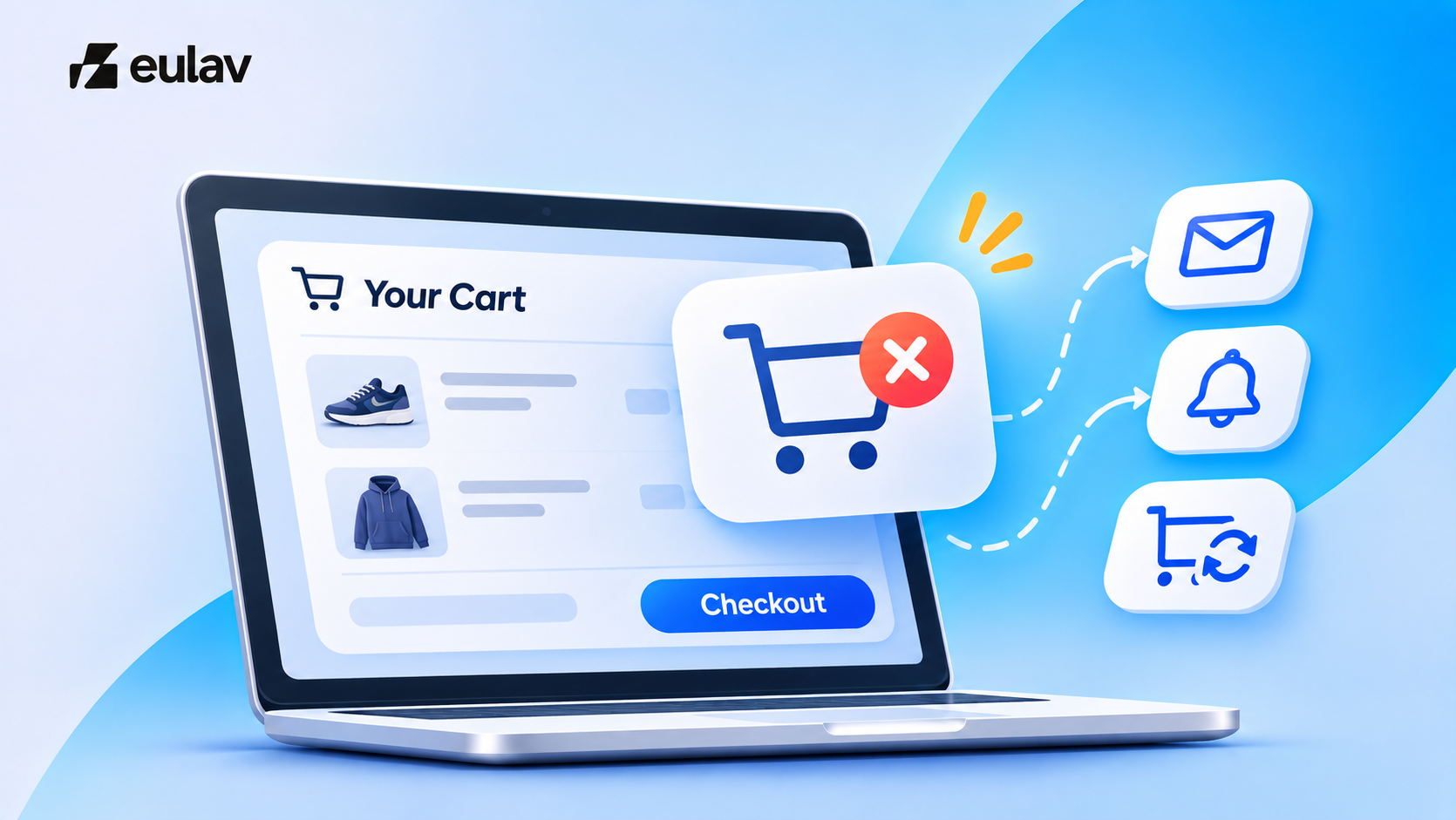
Quick answer: The average documented cart abandonment rate is about 70.22%, based on 50 studies. The biggest cause of Shopify cart abandonment is extra costs showing up late, cited by 40% of shoppers. Fix cost clarity, speed and trust at checkout first, then test one change at a time.
Figures last updated 22 September 2025. Checked 2 November 2026. Eulav is our product.
Shopify cart abandonment: why shoppers leave
Reasons shoppers give for abandoning a cart, excluding shoppers who were just browsing:
| Reason | Share |
|---|---|
| Extra costs too high (shipping, tax, fees) | 40% |
| Delivery too slow | 20% |
| Distrust of the site with card details | 19% |
| Site required an account | 18% |
| Checkout too long or complicated | 17% |
| Website errors or crashes | 17% |
| Unsatisfactory returns policy | 13% |
| Total cost not visible up front | 12% |
| Credit card declined | 10% |
| Too few payment methods | 9% |
Separately, 42% of US online shoppers said they abandoned a cart because they were just browsing or not ready to buy. Source: Baymard Institute.
Start at the top of this list. Show the full cost early, make delivery times clear, and add trust signals at checkout, then test one change at a time.
Match each reason to a fix
The table shows why shoppers leave. This section turns the top five reasons into actions you can take this week.
| Reason (share of shoppers) | What to do |
|---|---|
| Extra costs too high (40%) | Show shipping, tax and fees on the product and cart pages, not for the first time at checkout. |
| Delivery too slow (20%) | State delivery dates early. Offer a faster option if you can, and be honest if you cannot. |
| Distrust of the site with card details (19%) | Show recognised payment methods, secure payment cues and a clear returns policy near the pay button. |
| Site required an account (18%) | Offer guest checkout. Ask for an account after the order, not before. |
| Checkout too long or complicated (17%) | Remove optional fields, keep steps to the minimum and let shoppers edit the cart without starting over. |
How to measure it. Cart abandonment is the share of carts created that do not end in an order. Track it weekly, and compare the same days each week so a busy weekend does not mislead you.
Where to start. Fix the first row first, because it affects the most shoppers. Change one thing, wait a full week or two, then check whether the rate moved before you change the next.
Abandoned carts also include people who were only browsing, so do not expect to recover them all.
What to fix first on Shopify
- Show the full cost early. Display shipping thresholds and estimated delivery on the product page and cart, not first at checkout.
- Offer guest checkout. Forcing an account is a top-five cause.
- Shorten checkout. Remove fields you do not use.
- Add trust signals near payment. Returns policy, secure payment cues and recognised payment methods.
- Check for errors on mobile. Test the full flow on a phone.
- Then recover what is left. Abandoned cart emails and retargeting win back some shoppers who intended to buy.
For more, see our guides to Shopify checkout optimization, abandoned cart retargeting and reducing cart abandonment without discounts.
How to tell what is hurting your store
Averages hide your pattern. Look at where in the funnel shoppers drop (cart, shipping, payment) and by device. A drop at the shipping step points to cost. A drop at payment points to trust or payment options.
Test before you roll out
A fix that helps one store can hurt another. Run the change as a test for 7 to 14 days and keep the winner.
Related reading
Keep going with ecommerce optimisation tools that increase sales and the best CRO tools for ecommerce.
Where Eulav fits
Recover more of the sales you are losing at checkout, and see a measurable lift in your first 30 days, or get a refund. Eulav is an AI-powered revenue optimisation platform for Shopify stores. It scans your store, shows the blockers costing you sales, and runs optimisations you approve. Eulav picks and runs each optimisation, and nothing goes live without your approval. Your original site stays as it is.
Spending on traffic? Eulav is the companion to every dollar you spend on new or returning visitors, from paid ads to email, SMS and retention. At 1,000 visits, lifting conversion from 2% to 2.5% turns 20 orders into 25, with no extra ad spend.
See what Eulav finds in your own store. Start with free opportunity finding and 2 tests.
Built for your category: Shopify CRO for fashion, beauty, supplement, jewellery, footwear brands. Comparing tools? See alternatives to Intelligems, Shoplift, Hotjar, Convert.
Make the most revenue from your current channels today. Start with free opportunity finding and 2 optimisations. No card, 60-second setup.
FAQ
About 70.22% across 50 studies.
Extra costs that are too high, at 40%.
Show costs early, offer guest checkout, shorten checkout, build trust, then test.
They recover some sales, but fixing the cause is cheaper than chasing shoppers afterwards.