Most ecommerce stores are built on a dangerous assumption: that more traffic solves everything. So owners pour money into ads, chase new audiences, and watch their cost per acquisition quietly climb. Then one slow month arrives and the math stops working. The traffic is there. The sales are not.
The fix is not more traffic. It is building a store experience so good that the visitors you already have actually buy, come back, and bring others. That is what a sustainable ecommerce business looks like. This guide walks you through exactly how to build one, step by step.
Step 1: Audit Your Store Before You Do Anything Else
You cannot fix what you cannot see. The first step toward a sustainable ecommerce business is understanding where your store is failing visitors right now, before changing a headline, redesigning a page, or launching another campaign.
Most store owners skip this. They optimize by instinct, testing one element here, adjusting copy there, without ever knowing whether those were the highest-impact problems to solve. The result is months of work that barely moves the needle.
A proper ecommerce CRO audit examines four areas: how visitors find and navigate your store, where they drop off, how your product pages perform, and where your checkout flow breaks down. Done right, it gives you a ranked list of fixes ordered by revenue impact. According to our guide to CRO audits, acquisition costs for ecommerce brands have risen over 40% in two years, which means optimizing the traffic you already have is no longer optional. It is the only sustainable path.
The fastest way to run this audit today: Let AI scan your store in under 60 seconds and surface exactly what is killing conversions.
Step 2: Fix Your Conversion Rate Before Scaling Traffic
Here is the number every ecommerce owner needs on their wall: the global average ecommerce conversion rate sits between 1.65% and 2.7%. That means for every 100 people visiting your store, fewer than three are buying. And if you are below the average in your category, the gap compounds with every dollar you spend on ads.
Before you scale a single campaign, close that gap.
The three highest-impact areas to fix first are:
- Product pages: Does your copy answer “is this right for me” clearly and immediately? If a shopper has to think about it, they leave. Strong product pages use specific language, multiple angles of imagery, and social proof positioned near the buy button, not buried below the fold.
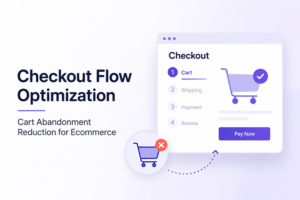
- Checkout friction: Roughly 70% of shopping carts are abandoned before purchase, according to Baymard Institute’s analysis of 49 studies. Unexpected shipping costs, forced account creation, and too many form fields are the top culprits. A guest checkout option alone can recover a meaningful share of those lost sales.
- Mobile experience: Mobile commerce now accounts for over 60% of ecommerce sales globally, but mobile cart abandonment sits at 85.65% compared to 73.76% on desktop. A one-second delay on mobile drops conversions by up to 20%. If your mobile experience is slow or clunky, you are losing the majority of your potential customers before they reach checkout.
A mid-sized store spending $50,000 monthly on ads improved conversion from 2.1% to 3.0% without touching its ad budget. The improvement came entirely from fixing product page messaging and checkout friction surfaced through behavioral data. That single change added meaningful monthly revenue with zero additional acquisition spend.
Your store is leaking revenue right now. Run an audit and get a prioritized fix list in minutes.
Step 3: Build Trust at Every Stage of the Buyer Journey
Traffic and conversion mean nothing if visitors do not trust your store enough to hand over their payment details. Trust is not one element on your product page. It is distributed across every interaction a shopper has with your brand, from the first ad they see to the post-purchase email in their inbox.
The building blocks of ecommerce trust are more practical than most brands realize:
- Transparent pricing: Display shipping costs, taxes, and delivery timelines before the final checkout step. Surprise fees at checkout are the single most cited reason for abandonment.
- Real reviews, including the negative ones: No marketing copy outperforms genuine customer reviews. A balanced review profile, with timestamps and photos, builds credibility in a way a polished brand voice never can. Hiding negative reviews signals you have something to hide.
- A human brand: Customers do not trust faceless stores. An About page that tells your real story, social media that shows the people behind the business, and responsive customer service turn a transactional experience into a relationship.
- Frictionless returns policy: A clear, easy return process reduces purchase anxiety before it becomes a barrier. It signals confidence in your product.
Oliver Charles, a DTC apparel brand on Shopify, built retention around product confidence. Their “1-Week Challenge” gave first-time buyers a $50 refund for wearing the product daily and sharing photos. Customers who completed it were 50% more likely to return. Trust is not just built before the sale. It is reinforced through the entire ownership experience.
Step 4: Turn One-Time Buyers Into Repeat Customers
This is where sustainable ecommerce actually compounds. Acquiring a new customer costs five to 25 times more than retaining an existing one. And returning customers spend 67% more per transaction than first-time buyers. The math on retention is simply better than the math on acquisition, and most stores dramatically underinvest in it.
The highest-leverage retention tactics to build into your store now:
- Post-purchase email sequences.
The window immediately after a purchase is your highest-engagement moment. A sequence that includes a genuine thank-you, product education, and a well-timed repurchase prompt outperforms any cold campaign. Personalized messaging drives 50% better customer re-engagement than generic sends.
- Loyalty programs built around real value.
Points schemes work when redemption is easy and rewards feel meaningful. Keep it simple: reward repeat purchases, reviews, and referrals.
- Subscription and replenishment options.
For consumable products, subscriptions are one of the most powerful retention tools available. Three-quarters of ecommerce businesses plan to offer subscriptions specifically because recurring revenue reduces churn and compounds LTV. Allowing customers to pause instead of cancel reduces cancellations by 20% and reactivates 12% of dormant users.
See what Revvy finds in your own store, no card required.
- Segmented win-back campaigns.
A customer who has not purchased in 90 days needs a different message than a fresh buyer. A targeted sequence acknowledging the gap and offering a relevant incentive consistently outperforms blanket discount campaigns.
Eulav’s customer retention strategies guide covers how stores at different stages prioritize these tactics based on where they are in their growth cycle.
Step 5: Use AI to Stop Revenue Leaks Before They Cost You
The shift happening in ecommerce right now is not about adopting AI for its own sake. It is about the gap growing between stores that can identify and fix conversion problems at speed and those still relying on manual analysis that takes weeks.
68% of CRO professionals now use AI-powered personalization tools, and the results are measurable. Wayfair implemented advanced AI personalization for product recommendations and user experiences. The result was a 40% improvement in conversion alongside a reduction in return rates, because more relevant product matches meant fewer buyers experiencing regret.
For stores that do not have Wayfair’s engineering team, Revvy AI solves this from the other direction. Rather than requiring you to interpret analytics and draw your own conclusions, it translates behavioral data into specific directives. Instead of “checkout has a 70% drop-off rate,” you get “your CTA button is below the fold on mobile, move it 200 pixels up.” That specificity is the difference between an insight and a fix.
Bailey and Coco, a DTC brand using Eulav AI agent during a typically slow post-Black Friday period, saw conversion rate jump from 3.05% to 3.93%, a 28.9% improvement. Mobile search conversion improved by 46.7%. Cart-to-checkout rate climbed 12.7%. All on the same volume of traffic. The variable that changed was not audience size. It was the number of visitors who reached checkout with enough confidence to complete the purchase.
The metrics that confirm your store is on a sustainable path are simple: repeat purchase rate, CLV relative to CAC, and conversion rate by traffic source. For different store categories, from single-product DTC brands to subscription models to luxury ecommerce, the benchmarks shift. The stores that scale are the ones measuring the right numbers for their specific model, not chasing vanity metrics.
FAQ: How to Build a Sustainable Ecommerce Business
The global average sits around 1.65% to 2.7%, but industry and traffic source matter significantly. Food and beverage brands average 4.5% to 6%, while luxury and jewelry typically convert between 0.8% and 1.2%. Rather than chasing a universal benchmark, focus on improving your own rate consistently over time.
If your traffic is stable but revenue is not growing proportionally, or if your cart abandonment rate is above 70%, your store almost certainly has friction points hurting conversion. An AI-powered audit surfaces these issues faster than manual analysis and ranks them by revenue impact.
Stores using Revvy AI typically see measurable conversion improvements within 30 to 45 days of implementing the recommended fixes. Some changes, like repositioning a CTA or removing a checkout field, can show impact within days.
Rarely. The highest-impact CRO improvements are almost always targeted fixes, not full redesigns. Checkout friction, mobile performance, trust signals, and product page clarity tend to deliver the biggest gains with the least disruption.
No. A 1% increase in conversion rate on a store generating $10 million annually adds $100,000 in revenue without additional ad spend. For smaller stores, even a half-point improvement can be transformational. The fundamentals of good conversion optimization apply at every scale.