You built the ad. You wrote the product copy. You got the click, the add-to-cart, even the email address. Then, right at the finish line, the customer vanishes. No purchase, no explanation, just an empty notification where a sale should have been.
If that scene feels familiar, you are not running a broken store. You are running a normal one. The average ecommerce checkout sees roughly 70% of carts abandoned before purchase, a figure that has barely moved in a decade according to Baymard Institute’s compiled research. The good news buried inside that statistic is bigger than the bad news: a large share of that abandonment is fixable, not fated. Unexpected costs at checkout, clunky form fields, forced account creation, and slow-loading mobile pages are not personality flaws of your customers. They are checkout flow optimization problems, and they have known solutions.
This is where most store owners get stuck. They can see that people are leaving, but not why, and definitely not what to fix first.
Let AI audit your live store, flag the specific friction points draining your conversion rate, and hand you a prioritised fix list in minutes.
Why Shoppers Abandon Carts (And Why It Is Rarely About Your Product)
Not every abandoned cart is a lost sale. A meaningful portion of shoppers add items purely to browse, compare, or save for later, behavior researchers consider largely unavoidable. But once you strip out window shoppers, the remaining causes are almost entirely about friction, not desire.
Surprise costs are the single biggest culprit. When shipping fees, taxes, or service charges appear for the first time at the final step, a near-majority of shoppers close the tab on the spot, according to the same Baymard data referenced above. Forced account creation and slow estimated delivery windows round out the next two most common reasons. None of these involve the product being wrong for the customer. They involve the path to purchase being harder than it needed to be.
A few patterns worth watching in your own store:
- Mobile carts are abandoned at a noticeably higher rate than desktop carts, often by 10 to 15 percentage points, which matters enormously now that most ecommerce traffic arrives on a phone.
- The average checkout form still asks for more fields than necessary; usability testing suggests well-optimized flows can cut form fields by 20 to 60 percent without losing any required data.
- Health, beauty, and wellness categories tend to see above-average abandonment, often tied to higher price sensitivity and more comparison shopping before purchase.
None of this means your brand is underperforming. It means checkout, not the product page, is usually where revenue quietly leaks out.
The Real Cost of an Unoptimized Checkout
It is tempting to treat a high abandonment rate as background noise, the kind of metric you glance at and move past. But the dollar figure attached to it is hard to ignore. Researchers at Baymard estimate that better checkout design alone could recover a meaningful share of otherwise-lost orders across large US and EU retailers, a figure that runs into the hundreds of billions when aggregated across the industry. Scaled down to a single mid-size DTC brand, even a few percentage points of recovered checkout conversion can mean tens of thousands of dollars a month that were already sitting in the cart, just never collected.
Brands that have taken checkout friction seriously tend to see it pay off quickly. Wayfair’s large-scale checkout testing work, documented through Baymard’s UX research program, has repeatedly shown that trimming unnecessary steps and clarifying cost breakdowns moves conversion in a measurable way.
DTC apparel brand Bailey and Coco saw a similar lift after restructuring its checkout to surface shipping costs earlier in the funnel rather than at the final screen, a small interface change with an outsized revenue effect. The lesson is consistent across categories: checkout is not a “set it and forget it” page. It is a living part of the funnel that compounds in either direction, leaking revenue when ignored, recovering it when tuned.
This is precisely the kind of audit work that used to require a UX consultant and a multi-week engagement. AI condenses that audit into minutes.
Scan your store for the specific friction points pulling your numbers down and fix it.
Fixing the Checkout Flow Without a Full Redesign
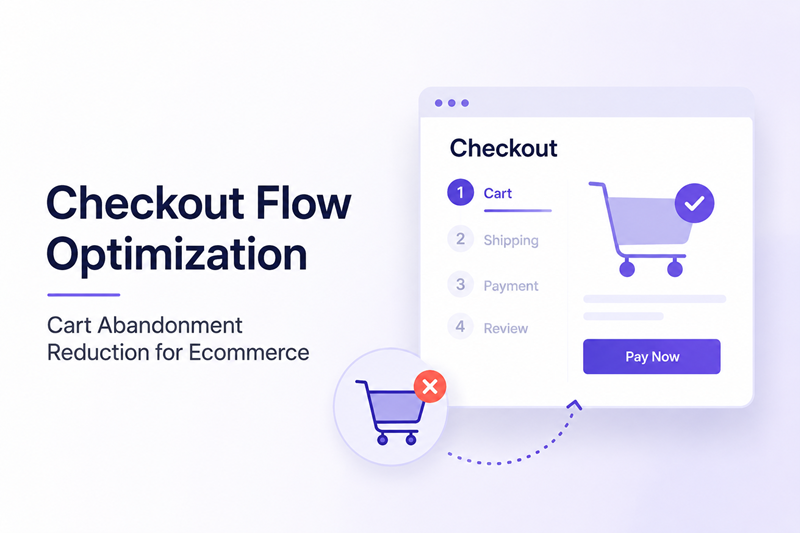
The instinct when abandonment numbers look bad is to rebuild the entire checkout from scratch. That is rarely necessary, and it is often the slower, riskier path. Most stores recover the bulk of their lost conversions through a handful of targeted changes rather than a full overhaul.
- Start with cost transparency.
Showing an estimated total, including shipping and tax, as early as the product or cart page removes the single most common trigger for last-minute abandonment. Pair that with a visible free-shipping threshold banner; shoppers who can see they are a few dollars from free shipping tend to add more to their cart rather than abandon it.
- Next, look at guest checkout.
Mandatory account creation remains one of the more avoidable conversion killers, and offering a guest option consistently lowers abandonment without sacrificing the ability to collect an email later in the flow. Combine that with form-field reduction. Audit your checkout for fields that exist out of habit rather than necessity, and consider autofill and address validation to speed up mobile entry, where typing friction is highest.
Finally, treat your mobile checkout as its own product, not a smaller version of desktop. Button size, load speed, and one-tap payment options like accelerated checkout buttons make an outsized difference on phones, where attention spans are shorter and distractions are constant.
See what Revvy finds in your own store, no card required.
If that list feels like a lot to prioritize alone, that is exactly the bottleneck Revvy was designed to remove. Rather than testing changes blind, an automated audit shows you which of these issues are actually costing your specific store money, so the fix list reflects your real data instead of generic best practices.
For deeper guidance on related conversion levers, our team breaks down pricing page psychology and trust signals, mobile commerce UX benchmarks, and how leading DTC brands structure their funnels in more detail.
Turning Checkout Audits Into Ongoing Revenue
Optimization is not a one-time project. Shopper expectations shift, your product mix changes, and what worked last quarter can quietly stop working as your traffic sources evolve. Brands that treat checkout as a permanent feedback loop, watching abandonment trends, testing one variable at a time, and re-auditing after major site changes, consistently outperform brands that optimize once and move on.
Gymshark and MVMT Watches, both frequently cited in ecommerce UX research for high-performing checkout flows, share a common habit: they revisit their funnel data on a regular cadence rather than waiting for a quarterly review to notice a problem. That habit is easier to build when the audit itself does not require pulling in an outside agency every time. Running a fresh diagnostic whenever you launch a new product line, switch payment providers, or notice a dip in conversion keeps friction from quietly compounding.
If you want a clearer picture of where your own store stands right now, rather than relying on industry averages that may not reflect your customers, start a free audit and see your specific friction points in minutes. For more on building a recurring optimization habit, see our breakdown of conversion rate optimization frameworks and post-purchase retention strategies that keep recovered customers coming back.
FAQs: Checkout Flow Optimization Cart Abandonment Reduction for Ecommerce
It is the practice of identifying and removing friction in the steps between adding a product to cart and completing payment, including form length, cost transparency, payment options, and page speed.
Industry averages hover near 70%, so anything noticeably above that for your specific vertical usually points to a fixable checkout issue rather than a product problem.
Yes. Mobile shoppers abandon at higher rates due to smaller screens, slower typing, and more distractions, so larger tap targets, autofill, and one-click payment options matter more there than on desktop.
Yes. Because abandonment happens after a customer has already shown intent, recovering even a small percentage of those carts increases revenue without spending more on acquisition.
After any major site, pricing, or payment provider change, and at minimum once a quarter, since shopper expectations and platform updates shift over time.
Cart abandonment is not a verdict on your brand. It is a map of exactly where your checkout is losing trust, clarity, or speed, and every point on that map is fixable once you can see it clearly.