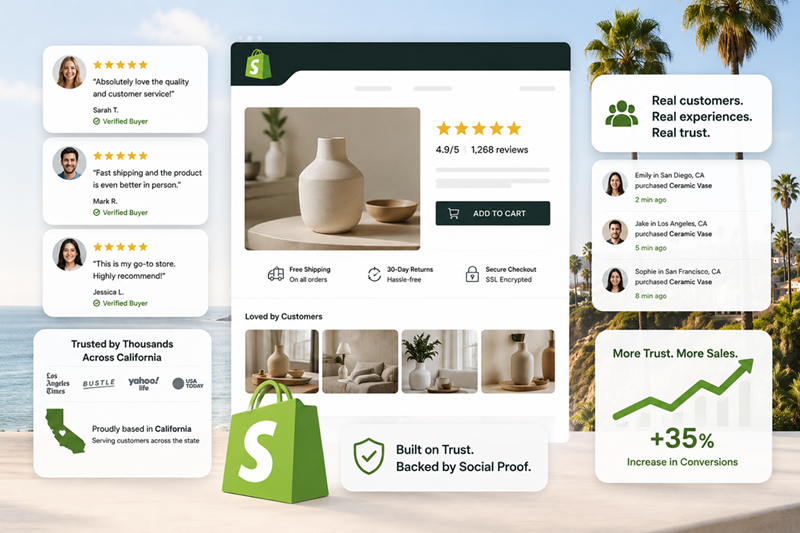
Your Shopify store is getting clicks, people are browsing your products, and your ad spend keeps climbing. But the revenue is not following. If that sounds familiar, the problem is not your product. It is not your traffic. It is trust.
Shoppers in California and across the United States have become significantly more research-driven and review-dependent than at any prior point in ecommerce history. When a visitor lands on your product page and sees no reviews, no customer photos, and no visible signal that anyone has bought from you before, their brain files your store under “uncertain.” And uncertain does not buy. The fix is not a redesign or a new ad campaign. It is a deliberate, data-backed social proof strategy built directly into your Shopify store.
The stores that solve this quickly are the ones running a full diagnostic first. If you want to know exactly where your store is losing trust and what to fix before your next traffic push, scan your store now.
Why Social Proof Is the Highest-ROI Lever in Ecommerce Right Now
The research on this is not ambiguous. The Spiegel Research Center at Northwestern University found that displaying reviews increases conversion rates by 270% for higher-priced products. That number is not a rounding error. It reflects the measurable impact of one of the most foundational human behaviors in commerce: we look to other people’s experiences before we commit to our own.
The Spiegel Research Center found that the conversion lift from reviews is steepest between zero and five reviews. Going from zero to five reviews produces a larger percentage lift than going from five to fifty. For Shopify store owners, this is significant. You do not need hundreds of reviews to see a meaningful conversion improvement. You need to get the first five on every product page that currently has none.
92% of consumers hesitate to purchase when no reviews are available. The absence of social proof creates significant friction, with 92% of buyers hesitating when reviews are missing entirely. In a market where the average Shopify store converts at just 1.4%, that hesitation is the difference between a profitable store and one that bleeds ad spend without return.
Research shows that 70% of consumers trust online reviews as much as personal recommendations. Your customer reviews are not supplementary content. They are your most persuasive sales asset.
The Types of Social Proof That Actually Move Conversion Rates
Not all social proof is created equal. The format, placement, and volume of your trust signals each carry different weight depending on your product category, price point, and traffic source.
Star ratings and written reviews remain the most impactful format for purchase conversion. They reduce perceived risk at the exact moment a shopper is deciding whether to add to cart. Research from Northwestern University’s Spiegel Research Center shows that purchase likelihood tends to peak at ratings around 4.2 to 4.5 stars rather than perfect 5.0 ratings. Authentic review profiles including constructive criticism actually improve conversion rates compared to artificially perfect ratings. This matters operationally: do not suppress negative reviews. They make the positive ones believable.
Photo and video reviews carry additional weight because they address one of the core anxieties of online shopping: the gap between what a product looks like in marketing photos and what it actually looks like in real life. A skincare brand on Shopify, for example, that surfaces customer before-and-after photos on its product pages compresses the trust-building timeline considerably. The shopper does not need to imagine the result. They can see it.
Verified buyer badges serve a specific function. Identifying purchasers with verified buyer badges enhances the credibility of a review and improves the odds of purchase by 15%. The badge signals that the review was written by someone with actual skin in the game, not an anonymous visitor.
Real-time purchase notifications and trust signals near the add-to-cart button are behavioral triggers. When a shopper sees that someone in their region purchased the same product 20 minutes ago, it activates social consensus. Combined with trust badges, money-back guarantees, and clear return policies placed adjacent to your CTA, these elements reduce the psychological friction that causes shoppers to pause and leave.
Your store’s social proof gaps are likely costing you more than you think. Eulav’s AI engine audits your product pages and surfaces exactly which trust signals are missing and where, so you are fixing the right things in the right order.
Where California Merchants Are Leaving Conversion on the Table
California is one of the highest-volume ecommerce markets in the United States. It is also a market where consumer expectations around transparency, product authenticity, and brand accountability are measurably higher than national averages. Shoppers here are informed. They cross-reference. They read reviews not just on your site but on third-party platforms, Reddit threads, and social channels before committing to a purchase.
This means the social proof gap is more acute for California-based Shopify stores and for brands targeting California consumers. A store with two reviews on its flagship product page is not competitive in this environment, regardless of how strong its paid traffic is.
Top-performing Shopify stores have hundreds or thousands of reviews, with recent reviews within the last 30 days, photo reviews, and verified buyer badges. Their product pages surface reviews within the visible page area without requiring scrolling. That last point is critical. Review placement is not decorative. Reviews displayed above the fold convert 15 to 25% better than reviews buried at the bottom of the page. If your reviews live below a long product description and a specifications table, most mobile shoppers will never see them.
For a practical deeper dive on the structural conversion issues that accompany thin social proof, the ecommerce conversion optimization audit guide on Eulav walks through ten specific strategies with clear prioritization logic. If your store is not converting at the rate your traffic quality deserves, the full breakdown of why your Shopify store is not converting covers the eight most common root causes, including the trust deficit that social proof directly solves.
See what Revvy finds in your own store, no card required.
How to Add Social Proof to Shopify: A Practical Implementation Framework
Implementation does not need to be complex. The highest-impact moves are also among the simplest:
- Place star ratings and review counts on collection pages and in product thumbnails, not just on the product page itself
- Surface your three most recent, most detailed reviews within the first scroll depth on every high-traffic product page
- Add a photo review carousel above the fold, adjacent to the primary product image
- Place a trust badge cluster (secure checkout, money-back guarantee, free returns) directly below the add-to-cart button
- Enable automated post-purchase review request emails to build review volume consistently over time
The sequencing matters. Fix review placement before layering on new review collection strategies. Existing reviews that shoppers cannot see are already doing zero work. Make them visible first.
For stores with low review volume, the priority is velocity. Focus your review request outreach on your three to five bestselling products. The Spiegel Research Center found that products with five or more reviews are 270% more likely to be purchased than products with no reviews. Getting five reviews on your highest-traffic pages is more valuable than getting fifty reviews on a product that receives minimal traffic.
The ecommerce navigation best practices guide on Eulav and the guide on ecommerce search features that improve CRO both address how product discoverability and review visibility intersect. Social proof only converts when shoppers can find the products it is attached to. Navigation and search architecture determine whether that happens.
For stores investing in content testing and optimization, the Eulav guide on turning browsers into buyers covers how to measure the conversion impact of social proof placements through structured testing rather than guesswork.
Most stores have more social proof than they are displaying effectively. Let Eulav’s AI agent show you exactly where your trust signals are missing, misplaced, or underperforming so you can fix what is actually costing you revenue.
FAQ: Add Social Proof to Shopify California
Social proof includes customer reviews and star ratings, photo and video testimonials, verified buyer badges, real-time purchase notifications, trust badges near checkout, media mentions, and user-generated content. Each type serves a different function in reducing buyer hesitation at different stages of the purchase journey.
Research from the Spiegel Research Center indicates that the conversion lift is steepest between zero and five reviews. Getting five authentic reviews on a product page with none is more impactful than adding fifty reviews to a page that already has a hundred.
Yes. Review content generates fresh, keyword-rich text that search engines index. Products with consistent review activity tend to accumulate long-tail search visibility over time. Social proof also reduces bounce rates and improves time-on-page, both of which are behavioral signals that correlate with organic ranking performance.
Reviews should appear above the fold on desktop and within the first two scroll depths on mobile. Star ratings should be visible on collection pages and in product thumbnails. Do not place reviews only at the bottom of the page, where the majority of mobile shoppers will never reach them.
A store-level audit that surfaces specific product pages missing reviews, identifies trust signal placement gaps, and ranks issues by revenue impact is the fastest diagnostic method. Manually reviewing each page is time-consuming and prone to missing systemic issues that only become visible in aggregate funnel data.