Your store is getting traffic but sales are not keeping up. You are not alone. Most ecommerce brands running paid ads, publishing content, and investing in SEO still watch visitors leave without buying. The traffic is there. The problem is everything happening after the click.
The average ecommerce conversion rate sits at just 1.81% across 18,000 stores, which means roughly 98 out of every 100 visitors leave without purchasing. Meanwhile, cart abandonment averages 70.19% globally, according to Baymard Institute. That is not a traffic problem. That is a conversion problem, and a systematic ecommerce conversion optimization audit is how you find and fix it.
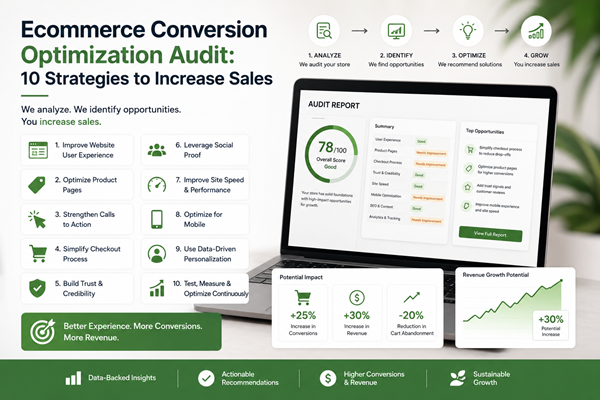
This guide walks through 10 high-impact audit strategies that reveal exactly where your store loses buyers and what you need to change to recover that revenue.
1. Start With a Full Funnel Conversion Audit
Before you fix anything, you need to see everything. A conversion rate optimization audit maps every step of your buyer journey, from the landing page to the confirmation screen, and flags where drop-off happens.
Most brands focus on homepage design or ad creative when the real friction lives in the checkout flow or product page. Eulav’s AI agent crawls your store, detects behavioral drop-off points in real time, and surfaces what is actually costing you sales.
Start by pulling these numbers in Google Analytics or your Shopify dashboard:
- Add-to-cart rate
- Cart-to-checkout rate
- Checkout completion rate
- Revenue per session by traffic source
Once you have baseline data, you have a map. The audit strategies below tell you what to look for at each stage.
Stop guessing what’s killing your conversions. Find and fix the hidden issues hurting sales in minutes.
2. Audit Your Page Speed and Core Web Vitals
Speed is a conversion killer that most store owners underestimate. Conversions can fall by up to 20% for every one-second delay on mobile, according to Shopify research. On mobile, where over 60% of ecommerce traffic now originates, that drop-off compounds fast.
Google’s Core Web Vitals, which include Largest Contentful Paint, Cumulative Layout Shift, and Interaction to Next Paint, directly affect both rankings and on-site experience. A store loading in under three seconds will consistently outperform one loading in five, even with identical products and pricing.
Run Google PageSpeed Insights on your homepage, top landing pages, and product pages. Look for unoptimized images, render-blocking scripts, and third-party apps slowing your load time. This is one of the fastest, highest-return fixes available in any ecommerce CRO audit.
3. Examine Your Product Page for Friction
Product pages are where purchase decisions are made. Yet most stores leave money on the table through vague copy, weak imagery, or missing trust signals.
Research from PowerReviews shows that user-generated content, including reviews, lifts conversion rates by over 102%. Fashion and apparel brands that added detailed sizing guides to product pages have reduced return rates and increased purchase confidence at the same time.
Audit every product page for these conversion blockers:
- No reviews or less than 10 reviews visible above the fold
- Images that fail to show product scale, texture, or use context
- Unclear or hidden shipping, return, and refund policies
- Add-to-cart button blending into the page design
MVMT Watches, a DTC brand that scaled to $100 million in revenue before being acquired by Movado, built its product pages around high-quality lifestyle photography and clear social proof. The formula is repeatable: clarity + credibility + a visible, compelling CTA.
4. Audit Your Mobile Checkout Experience
Mobile ecommerce has the highest cart abandonment rate at 85.65%, compared to 73.76% on desktop. That gap exists largely because most stores were designed for desktop first and adapted for mobile as an afterthought.
A proper ecommerce conversion optimization audit on mobile means walking through your full purchase flow on a smartphone, specifically on Android Chrome where the majority of mobile sessions happen. Look for:
- Form fields that are too small to tap accurately
- No guest checkout option (still one of the top abandonment reasons)
- Missing Apple Pay, Google Pay, or local payment options like Flutterwave for African markets
- Long checkout flows with more than four steps
Simplifying checkout to three steps or fewer consistently increases completion rates. Stikky, a Shopify mobile experience builder, reported a 15% boost in conversions after implementing Shopify’s checkout sheet kit. Small, focused changes in the checkout flow produce measurable revenue gains fast.
5. Run a Cart Abandonment Recovery Audit
Cart abandonment is predictable, which means it is recoverable. The average abandoned cart email achieves 41.8% open rates and 10.7% conversion rates, making it one of the highest-ROI channels in ecommerce.
Most brands send one generic recovery email 24 hours after abandonment. That is not a strategy. Eulav’s intelligent recovery engine detects cart abandonment behavior in real time and triggers personalized recovery sequences at the right moment, before the buyer fully disengages.
A sequence of two to three emails, timed at one hour, 24 hours, and 72 hours, with a small incentive in the final email, recovers significantly more revenue than a single blast. Audit whether your current recovery flow exists, what it says, and how quickly it fires.
Your abandoned carts are recoverable revenue. You can detect your car abandonment in real time and trigger recovery automatically using AI.
6. Review Your Trust Signals and Social Proof
Buyers do not convert on stores they do not trust. That sounds obvious, but trust gaps are one of the most common findings in a CRO audit for ecommerce because they are invisible until you look for them specifically.
Trust signals include visible security badges, clear return policies, recent reviews, press mentions, and social following counts where they are strong. According to McKinsey research, personalized trust signals, meaning showing a returning customer their previous order history or tailored recommendations, multiply the value of getting the experience right.
Gymshark, one of the most-studied DTC ecommerce success stories, built its early conversion engine almost entirely on community-driven social proof through athlete partnerships and user content. The lesson for independent brands is not that you need influencers. It is that real people talking about your product, visibly, converts better than anything your copywriting team can produce.
Audit where your trust signals appear, whether they are specific enough to be credible, and whether they show up at the right decision points in the buyer journey.
7. Analyze Your Traffic Sources Against Conversion Data
Not all traffic converts equally. Email traffic converts at 4% to 5.3%, while paid social traffic often sits below 1.2%. If your ecommerce CRO strategy is treating every visitor the same, you are losing revenue.
See what Revvy finds in your own store, no card required.
Pull a segment-by-segment breakdown in your analytics platform. Look at conversion rate, average order value, and bounce rate by source. You will almost always find at least one channel sending significant traffic that converts far below average. That channel either needs a dedicated landing page that matches buyer intent, or a reduced budget while you fix the experience.
Organic search from branded and high-intent keywords tends to convert well. Cold social traffic, especially from broad awareness campaigns, often needs a longer nurture sequence before converting. Matching your landing experience to traffic intent is one of the most reliable ways to increase overall conversion rate without changing a single product.
8. Audit Your Pricing Presentation and Offer Clarity
Unexpected costs are the number-one reason shoppers abandon carts, cited consistently across Baymard Institute, Shopify, and industry-specific research. Hidden fees, surprise shipping costs, or pricing that only becomes clear at checkout creates distrust that kills the sale.
Your audit here is straightforward: Add a product to cart and walk through checkout as a new customer. Note every moment where a cost appears for the first time. Then ask whether that cost could have been shown earlier without damaging the perceived value of the offer.
Brands like Warby Parker built a significant conversion advantage by making pricing clear, simple, and fixed early in the buying journey. The five-frame try-on program also removed the primary friction point, risk of a wrong choice, before it could stop the sale. You do not need a try-before-you-buy program to apply the principle: identify what makes buyers hesitate and remove or address it upstream.
9. Test and Audit Your CTAs and Copy
Generic calls to action underperform. Personalized CTAs convert up to 202% better than standard ones, according to research aggregated by Landbase. Most ecommerce stores use button copy like “Add to Cart” or “Buy Now” that communicates no benefit and creates no urgency.
Audit every primary CTA on your store. The question to ask is whether the button tells the buyer what they get, not just what they do. “Get Free Shipping on This Order” will outperform “Checkout” in most tests because it leads with the value to the buyer.
Test headline copy on product pages, email subject lines, and above-the-fold landing page copy using a structured A/B testing program. According to structured testing data from over 30 Shopify Plus stores, individual winning experiments have generated between $6,000 and $386,000 in additional monthly revenue. The highest-impact tests consistently involve product page layout and pricing presentation rather than color changes or cosmetic tweaks.
10. Use AI to Continuously Monitor and Fix Conversion Issues
The brands winning at ecommerce conversion rate optimization in 2025 and 2026 are not running one audit per year. They are monitoring conversion behavior continuously and fixing issues in near real time.
AI-powered CRO platforms like Eulav do what a manual audit cannot: watch thousands of individual buyer sessions simultaneously, detect patterns of drop-off as they emerge, and surface prioritized fixes ranked by revenue impact. The Eulav intelligent recovery engine is built specifically for this, detecting cart abandonment behavior in real time and acting on it before the buyer disengages permanently.
For a practical starting point, check out the Eulav guide to ecommerce revenue recovery and the conversion audit framework on their insights hub. These resources give you a structured path from audit to implementation without needing a full analytics team.
The brands doing this consistently, running audits, testing fixes, and using AI to monitor results, are the ones growing to 3%, 4%, and 5% conversion rates while their competitors stay stuck at 1.8%.
FAQs: Ecommerce Conversion Optimization Audit
It is a structured review of your store that identifies every point in the buyer journey where visitors drop off without purchasing. A good audit looks at page speed, checkout flow, trust signals, mobile experience, product pages, and traffic source data to find specific, fixable issues costing you revenue.
At minimum, quarterly. Fast-growing stores benefit from monthly audits or continuous AI-powered monitoring that flags issues as they appear rather than waiting for a scheduled review.
The global average sits around 1.81% to 2%, but a strong target for most stores is 3% to 4%. Food, beverage, and personal care brands regularly hit 5% to 6% due to lower price points and repeat purchase patterns. The more useful benchmark is your own baseline and whether your changes are moving it upward.
More traffic does not fix conversion problems, it amplifies them. If your conversion rate is falling as traffic grows, you are likely sending lower-intent visitors to a store with existing friction. An audit will show you which traffic sources are dragging your average down and which on-site issues are blocking purchase completion.
Cart abandonment recovery, page speed improvements, and checkout simplification consistently produce the fastest, most measurable results. These three areas address the most common and highest-volume drop-off points in any store’s funnel.