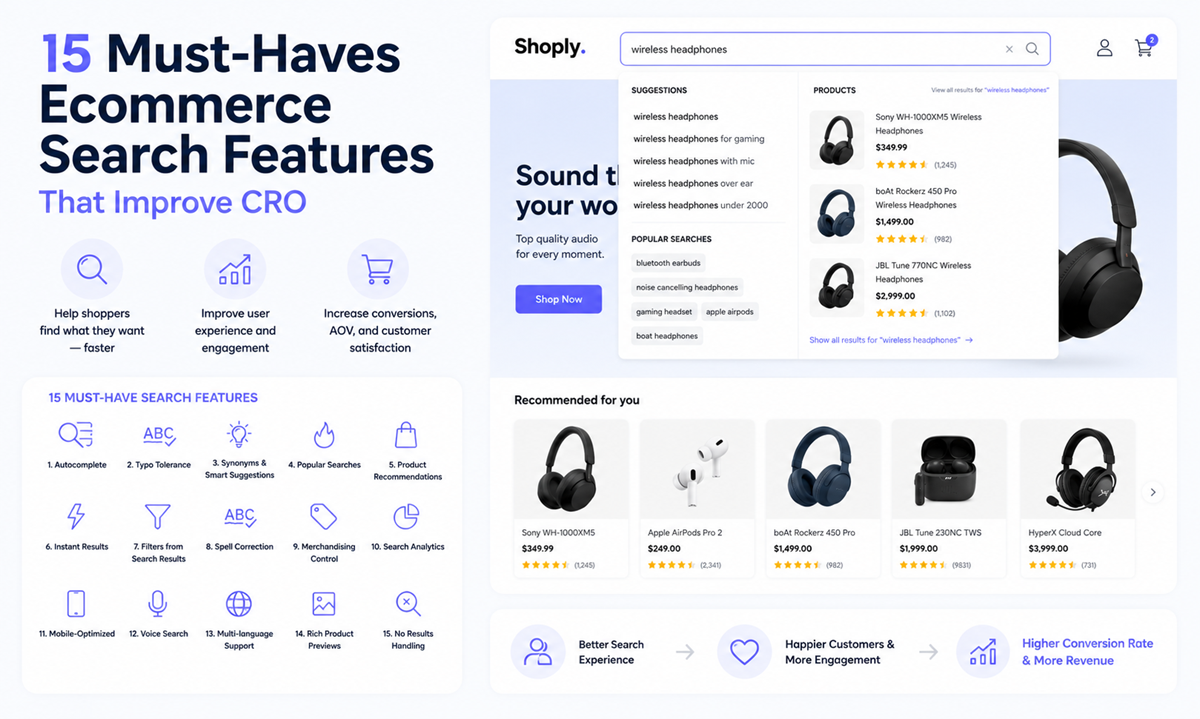
Your store is getting traffic. People are searching. And still, sales are leaking. The painful truth is that most ecommerce stores lose between 20% and 40% of potential revenue not because of bad products but because of broken search experiences that quietly push buyers away before they ever reach checkout.
The fix is not a redesign. It is precision. The right ecommerce search features eliminate friction at every touchpoint, and when paired with a tool that audits exactly where your store is hemorrhaging conversions, the results compound fast.
Audit your store and find what is killing sales in minutes. Find exactly what to fix, so you are not guessing.
Why Ecommerce Search Is a Conversion Rate Optimization Lever Most Brands Ignore
Shoppers who use on-site search convert at rates two to three times higher than those who browse. Yet the majority of ecommerce brands treat search as an afterthought. According to a study published by the Baymard Institute, roughly 70% of major ecommerce sites fail basic search usability standards. That is not a minor UX problem. That is a revenue crisis hiding in plain sight.
When Walmart revamped its internal search algorithm in 2023 to prioritize relevance signals over simple keyword matching, it reported measurable improvements in add-to-cart rates across categories. The logic applies at every scale.
The 15 Ecommerce Search Features That Directly Improve CRO
1. Autocomplete With Predictive Intelligence
Autocomplete reduces the effort required to find a product. But generic autocomplete that only completes exact phrases does very little. Predictive autocomplete that surfaces trending products, bestsellers, and category shortcuts inside the dropdown creates a guided path to purchase before the user has finished typing.
2. Typo Tolerance and Fuzzy Matching
A shopper who types “runninh shoes” or “wimen’s dress” should land on exactly what they meant. Without fuzzy matching, they hit a zero-results page and leave. Typo tolerance is not optional. It is the floor.
3. Synonym and Natural Language Recognition
Customers describe the same product in dozens of ways. “Sneakers,” “trainers,” “kicks,” and “athletic shoes” should all return the same results. Stores that build synonym libraries into their search index stop losing customers to language gaps.
4. Zero-Results Page Recovery
A zero-results page is one of the highest-exit moments in any ecommerce journey. Intelligent search systems catch these dead ends and redirect users toward the closest relevant results, popular alternatives, or curated categories instead of a blank wall.
5. Faceted Search and Dynamic Filtering
Once a shopper lands on results, their next move is to filter. The ability to narrow by size, color, price, brand, rating, and availability, without the page reloading each time, is a direct conversion driver. Research from the Nielsen Norman Group shows that well-implemented faceted navigation reduces task completion time significantly for product-heavy catalogs.
6. Search Relevance Tuning Based on Business Rules
Not every relevant result deserves the same position. High-margin products, overstocked SKUs, or seasonally relevant items should surface higher in results. Relevance tuning allows merchandising logic to work alongside algorithmic ranking, which is something many brands overlook until a competitor starts outperforming them on identical product ranges.
7. Personalized Search Results
When a returning shopper searches “jacket,” the results they see should reflect their size, past purchase history, and browsing behavior. Personalized search is no longer a luxury feature. Bloomreach’s 2023 commerce experience report found that personalized search experiences lift revenue per visitor by measurable double digits across mid-market retailers.
8. Mobile-Optimized Search UX
More than 60% of ecommerce traffic is mobile, yet most search interfaces are still designed desktop-first. A mobile-optimized search experience means large tap targets, voice input compatibility, and results that load without layout shift. Any friction here disproportionately hurts conversion because mobile users have shorter attention windows.
9. Visual Search
For fashion, home goods, and beauty, the ability to search by uploading an image rather than typing a query has moved from novelty to expectation. Pinterest’s internal data showed that its Lens visual search tool drove higher engagement among shoppers than text search for product discovery in style categories.
10. Search Analytics and Query Reporting
You cannot optimize what you cannot measure. Stores that monitor their top search queries, zero-result queries, and exit-after-search rates have a real-time window into demand signals and content gaps. This data is also one of the most underused inputs in ecommerce conversion rate optimization strategies.
If your store has gaps like these and you are not sure where to start, get a full audit of your store that shows every conversion blocker in priority order so your team can act fast without wasting cycles on guesswork.
11. Instant Search or Search-as-You-Type
Displaying results in real time as the user types collapses the distance between intent and action. Instant search reduces the number of steps between a search query and a product page, and fewer steps mean fewer drop-offs.
12. Search Merchandising and Promoted Results
The ability to pin specific products to the top of search results for commercial queries is a direct revenue lever. A search for “gift sets” three weeks before the holidays should surface your highest-converting gift bundles, not whatever the algorithm decides is most relevant. Search merchandising puts that control in the hands of your team.
13. Cross-Sell and Related Products in Search
Search results that surface complementary products (“people also searched for,” “frequently bought with”) extend basket size without any additional traffic spend. This feature alone can increase average order value when implemented with purchase-intent logic rather than generic recommendations.
14. Voice Search Compatibility
With smart speakers and voice-enabled mobile search growing, stores that structure their product data to support natural-language voice queries capture traffic that competitors still miss. Voice queries tend to be longer and more conversational, which means your search engine needs to parse intent rather than just keywords.
See what Revvy finds in your own store, no card required.
15. Search-Driven A/B Testing
Running experiments on search ranking logic, result layouts, and filter configurations gives ecommerce teams empirical data on what actually moves conversion metrics. Stores like ASOS have built iterative search testing into their core optimization cycles, continuously compounding small lifts into meaningful annual revenue gains.
The Hidden Conversion Killer Most Audits Miss
Most brands audit their paid media, their landing pages, and their checkout flow. Very few audit their search experience with the same rigor. The result is a category of revenue loss that stays invisible on dashboards but shows up clearly in aggregate bounce rates and session abandonment data.
Eulav’s intelligent recovery engine detects cart abandonment behavior in real time and pairs it with store audit data to surface exactly which friction points are costing you sales. Whether it is a broken filter on mobile, a zero-results loop for your top search terms, or a personalization gap that shows every shopper the same default results, the audit names the problem and the fix.
Find the search issues quietly costing you sales and see which fixes will have the biggest impact first.
What the Data Says About Search and Revenue
A study by Econsultancy found that internal site search can account for up to 45% of revenue on product-heavy ecommerce sites despite representing a fraction of total sessions. The revenue concentration around search users makes search optimization one of the highest-ROI activities available to ecommerce teams.
Separately, a study on ecommerce UX by the Interaction Design Foundation found that search abandonment drops significantly when stores implement at least seven of the fifteen features listed above in a cohesive way. Isolated improvements have smaller effects. Systemic search optimization compounds.
FAQ: Ecommerce Search Features and CRO
Typo tolerance and zero-results recovery consistently show the highest individual impact because they prevent shopper exit at the intent stage, before any product page is ever visited.
Personalized search reduces the cognitive load of browsing by surfacing products that match the individual shopper’s demonstrated preferences, which shortens the path to purchase and increases the likelihood of add-to-cart behavior.
Indirectly, yes. Search features that improve session depth, reduce bounce rates, and increase pages per session send positive behavioral signals that Google factors into organic ranking quality assessments.
A structured store audit is the fastest way to identify gaps. Eulav’s AI agent analyzes your store’s actual behavior data and surfaces the specific features and fixes that would have the highest conversion impact for your catalog and audience.
Yes, because the impact scales with your traffic. Even a modest 3% improvement in conversion rate from search users on a store doing moderate monthly revenue translates to compounding annual gains without any increase in ad spend.