You are not losing sales because your product is wrong. You are losing them because something between the click and the checkout is quietly breaking the buying decision, and most store owners never find out exactly what it is.
Conversion rate optimization (CRO) is one of the highest-leverage disciplines in ecommerce. A store converting at 3% instead of 1.5% on the same traffic volume doubles its revenue without spending an additional dollar on acquisition. Yet most stores are hemorrhaging conversions daily across predictable, fixable failure points. Understanding what those factors are, and more importantly how to resolve them, is the difference between a store that scales and one that stalls.
Factors Negatively Affecting Conversion Rate Optimization for Ecommerce Stores
Here are 10 factors actively suppressing your ecommerce conversion rate and what the data says you should do about each one.
1. Slow Page Load Speed
Baymard Institute research confirms that a one-second delay in page load time can reduce conversions by up to 7%. Visitors form a judgment about your store in under three seconds. If the page is still loading, the decision is already made. Compressing images, implementing lazy loading, and migrating to faster hosting infrastructure are not optional improvements. They are revenue decisions.
2. Poor Mobile Experience
Mobile accounts for over 60% of global ecommerce traffic, yet mobile conversion rates consistently lag behind desktop by a significant margin. A checkout flow designed for a cursor does not work for a thumb. Responsive design, simplified navigation, and mobile-native checkout are the baseline requirements for capturing this audience.
3. Complicated Checkout Process
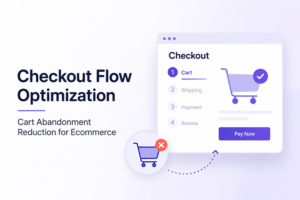
Every additional step in your checkout process is a statistical exit opportunity. Research from Baymard Institute shows that the average checkout flow contains 14.88 form fields, nearly twice what is necessary. Reducing friction at the checkout stage, through guest checkout options, autofill compatibility, and fewer required fields, produces measurable conversion lifts with no increase in traffic.
4. Lack of Trust Signals
Buyers are making financial decisions in an environment they cannot physically verify. If your store does not display security badges, verified reviews, clear return policies, and recognizable payment options prominently, you are creating a trust gap that skeptical buyers will not cross. Trust signals are not design accessories. They are conversion infrastructure.
If your store is experiencing any combination of these factors, the revenue impact is compounding every single day. The stores recovering that revenue are not spending more on ads. They are fixing what was already broken.
5. Weak Product Descriptions
A product description that lists specifications without addressing the buyer’s underlying motivation is a missed conversion. The most effective product copy answers the question the buyer is actually asking: will this solve my problem, fit my life, and justify the cost? Data-backed, benefit-oriented descriptions consistently outperform specification-heavy alternatives in conversion testing.
Pro Tip:
Find out and fix what’s hurting your conversion rate and turn more store visitors into paying customers in minutes using AI
6. No Social Proof
User-generated content, verified purchase reviews, and real customer outcomes are among the most statistically significant conversion drivers in ecommerce. A product page without social proof forces the buyer to make a decision in an information vacuum. That vacuum is almost always filled with hesitation.
7. Unclear Value Proposition
Visitors arriving at your store need to understand immediately what you offer, why it is better, and what they should do next. If that clarity does not exist in the first viewport, the bounce is almost certain. A strong, specific value proposition positioned above the fold is one of the fastest CRO improvements available to any store.
8. Poor Site Search Functionality
Visitors who use internal site search convert at rates between two and three times higher than those who browse passively. A broken, slow, or imprecise search experience is quietly eliminating your highest-intent buyers before they reach the product page.
9. Absence of Urgency or Scarcity
Behavioral economics research consistently demonstrates that loss aversion is a stronger motivator than equivalent gain. When inventory levels, limited-time pricing, or time-sensitive offers are communicated clearly and authentically, conversion rates improve measurably. The key word is authentically. False scarcity destroys the trust signals you worked to build.
See what Revvy finds in your own store, no card required.
10. No Post-Visit Recovery Strategy
The majority of visitors will not convert on their first session. If your store has no email capture strategy, no retargeting infrastructure, and no abandoned cart recovery sequence, you are losing buyers who were already interested enough to arrive. A structured recovery system turns lost sessions into deferred revenue.
Each of these 10 factors represents a recoverable revenue opportunity. Not a theoretical one. A documented, measurable one that stores are closing every day with the right diagnostic framework and the willingness to act on what the data reveals.
The question is never whether the problem exists. The question is whether you are currently equipped to see it clearly enough to fix it.
Pro Tip:
Uncover and fix the friction points damaging your customer experience and costing your store revenue every day.
FAQs: Factors Negatively Affecting Conversion Rate Optimization
The global average ecommerce conversion rate sits between 1% and 4%, with top-performing stores in specific niches reaching 5% or higher. The more useful benchmark is your own historical rate and how it trends over time relative to traffic quality.
Some fixes, particularly technical ones like page speed and checkout simplification, can show measurable results within days. Content and trust-signal improvements typically compound over four to eight weeks. CRO is a system, not a single intervention.
Unexpected costs at checkout, particularly shipping fees revealed late in the process, are consistently the leading driver of abandonment according to multiple Baymard Institute studies. Transparency earlier in the funnel reduces this significantly.
Disproportionately so. A store generating 5,000 monthly visitors that improves its conversion rate from 1% to 2% doubles its customer acquisition without additional ad spend. The smaller the store, the higher the relative impact of each conversion gained.
It is an ongoing discipline. Buyer behavior, device usage patterns, algorithm changes, and competitive dynamics shift continuously. Stores that treat CRO as a system rather than a project maintain compounding advantages over those that treat it as a one-time audit.