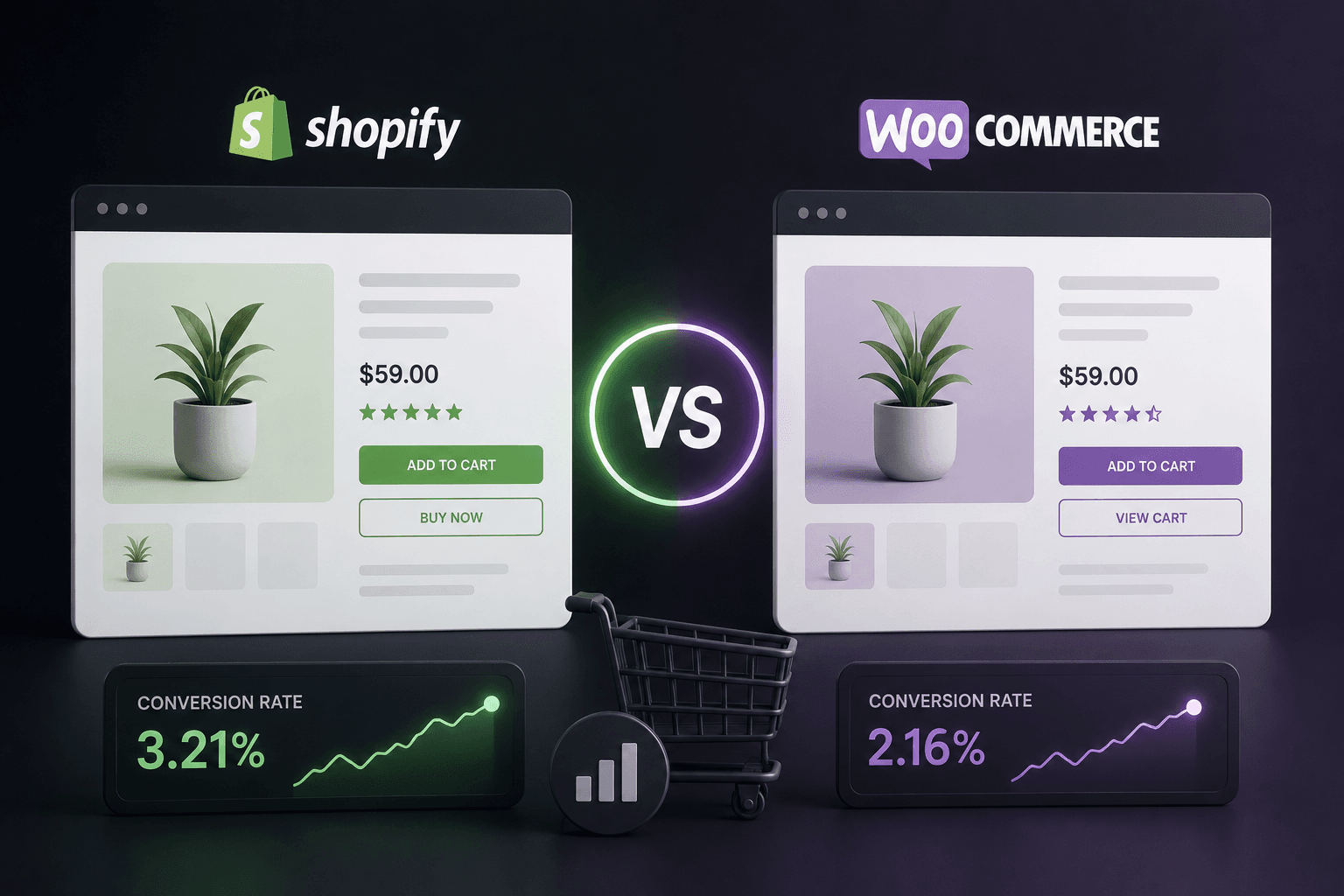
The shopify vs woocommerce conversion rate question comes up constantly, but neither platform has an inherent conversion advantage baked into its core architecture.
Neither platform has an inherent conversion advantage baked into its core architecture, but each has structural tendencies that shape how easy or hard it is to build a high-converting store on top of it.
Shopify vs WooCommerce conversion rate: where Shopify has an edge
Shopify’s checkout is standardized and heavily optimized by Shopify itself, which is part of why Shopify-specific cart abandonment tends to run slightly better than the broader ecommerce average. Payment options like Shop Pay are built in rather than requiring a plugin, reducing setup-related friction out of the box.
Where WooCommerce has a structural edge
WooCommerce’s flexibility allows deeper customization of the entire funnel, checkout fields, page layout, and integrations can all be tailored precisely to a specific business model in ways Shopify’s more locked-down checkout doesn’t always allow. That flexibility is also the risk: it’s easier to build something suboptimal without realizing it.
What actually determines conversion rate
Platform choice matters less than setup quality. A poorly configured Shopify store with excessive apps and a bloated theme can convert worse than a lean, well-built WooCommerce store, and vice versa. Both platforms can reach 3%+ conversion rates with proper optimization; both can sit well below 1% with neglect.
If you’re choosing between them
Choose based on your actual operational needs, customization requirements, existing WordPress infrastructure, team technical skill, rather than an assumption that one platform converts better by default. Once you’re on either platform, the fixes that move conversion rate are largely the same: checkout simplicity, product page trust signals, and mobile performance.
Neither platform is a shortcut around doing the actual optimization work.
Base any future platform conversation on your team’s actual operational reality, not assumptions carried over from this comparison alone.
Whichever platform you’re on, the deciding factor for long-term conversion success is consistent, ongoing attention to the funnel, not the platform’s name on the invoice.
If you’re currently on one platform and performing well, a platform switch driven purely by a marginal theoretical conversion advantage rarely justifies the disruption cost, reserve migration decisions for genuine operational or strategic needs rather than chasing an edge the data doesn’t clearly support either way.
Whichever platform you choose or stay with, the actual conversion-rate levers, checkout simplicity, mobile performance, trust signals, page speed, are largely the same. Platform choice shapes how easily you can pull those levers, not whether they exist to pull in the first place.
Reassessing the decision over time
A platform decision made at launch doesn’t have to be permanent, reassess periodically as your traffic, team, and customization needs evolve, rather than treating the original choice as locked in regardless of how much your business has changed since.
The bottom line on this comparison
If you’re choosing a platform today based partly on conversion potential, know that both can reach strong conversion rates with proper investment, and neither guarantees it without one. Weight your decision toward operational fit, team skills, budget structure, customization needs, over an assumed conversion advantage that the data doesn’t clearly support either way.
App and plugin ecosystem differences affecting conversion tooling
Shopify’s app store is more tightly curated and generally better tested for conflicts than WooCommerce’s broader plugin ecosystem, which can mean fewer unexpected compatibility issues when adding CRO-focused tools, though it also means fewer highly specialized options for unusual use cases that WooCommerce’s more open ecosystem accommodates.
Community and support resources as a practical factor
Shopify’s more centralized support and larger user community can mean faster answers to common conversion-related questions, while WooCommerce’s more fragmented (WordPress-wide) community sometimes requires piecing together answers from multiple sources. A real, if less quantifiable, factor in how quickly you can resolve issues that affect conversion.
Team skill set as a deciding factor
A team comfortable with WordPress and PHP will generally get more value from WooCommerce’s flexibility than a team without that background, who may be better served by Shopify’s more guided, less code-dependent environment, factor your actual team’s skills into this decision as heavily as any conversion-rate consideration.
Scalability considerations at high traffic volumes
Very high-traffic stores sometimes find Shopify’s managed infrastructure advantageous during traffic spikes (major sales events), where a poorly provisioned WooCommerce hosting setup can struggle without dedicated infrastructure investment, worth weighing your growth trajectory, not just current traffic, in this comparison.
Migration considerations if conversion is the deciding factor
Switching platforms purely to chase a conversion advantage is rarely worth the disruption, migrations typically cause a temporary conversion dip during the transition, and rebuilding accumulated trust signals (reviews, SEO history) takes time regardless of which platform you move to.
Total cost of ownership beyond conversion rate
Shopify’s pricing is predictable and bundles hosting, while WooCommerce’s total cost depends heavily on hosting quality, plugin licenses, and development time. A fair comparison needs to weigh total cost of ownership, not just conversion performance, since a cheaper platform with worse conversion can still cost more overall.
See what Revvy finds in your own store, no card required.
Common questions comparing Shopify and WooCommerce conversion
Which platform has better default checkout conversion?
Shopify’s checkout tends to convert slightly better out of the box due to standardization; a well-optimized WooCommerce checkout can close or eliminate that gap.
Does migrating platforms hurt SEO and conversion in the short term?
Often yes, temporarily, proper redirect mapping and a careful migration plan minimize this, but some disruption is close to unavoidable.
Is one platform better for A/B testing specifically?
Both support third-party testing tools; Shopify’s more standardized templates can make certain tests faster to set up than a highly customized WooCommerce build.
Shopify’s own CRO guide makes the same point about setup quality mattering more than platform choice.
Whichever platform you choose, shopify vs woocommerce conversion rate differences matter less than consistent optimization effort.
At the end of the day, the shopify vs woocommerce conversion rate debate matters less than consistent execution on either platform.
Related reading
- WooCommerce Conversion Rate Optimization: A Practical Guide
- Site Speed and Conversion Rate: How Much Milliseconds Actually Cost You
- Shopify Checkout Optimization: The Full Guide
Works the same way on either platform.
Shopify, WooCommerce, BigCommerce, Magento, or custom, same continuous optimization.