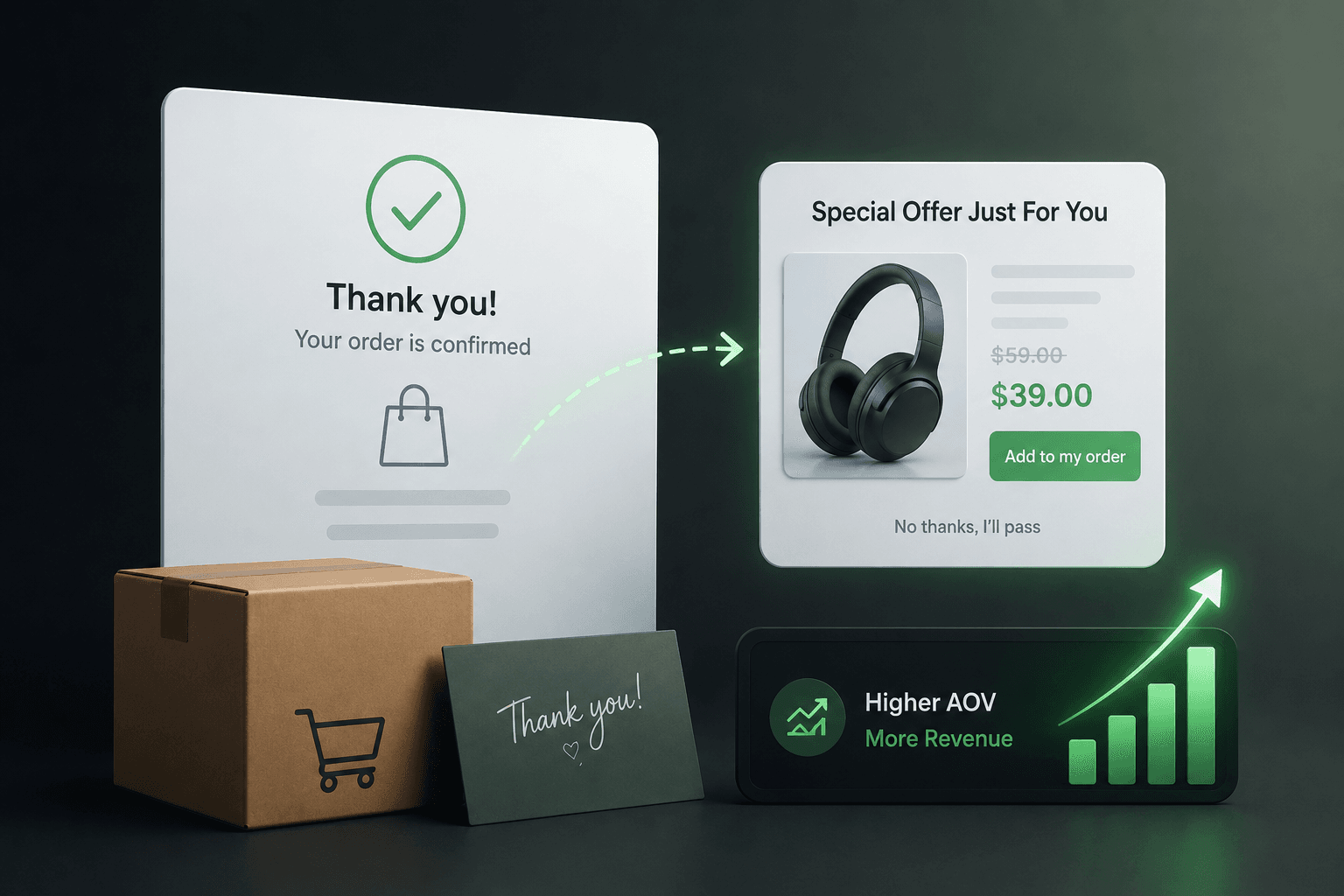
A post purchase upsell ecommerce strategy offers an additional item after checkout is already complete, not before. That timing matters. The primary sale is locked in, so the offer adds revenue without risking the original purchase the way a pre-checkout upsell can.
Why timing changes everything
A pre-checkout upsell interrupts the path to purchase. Every extra step or decision point before payment is a chance to lose the sale entirely. A post-purchase offer sidesteps that risk completely, since it only appears once the customer has already committed and paid.
Post purchase upsell ecommerce: what makes an offer actually convert
- Relevance to what was just bought. A generic “you might also like” performs worse than an offer clearly tied to the item just purchased, like an accessory, refill, or complementary product.
- One-click acceptance. The customer’s payment details are already on file. Requiring them to re-enter card information for a second purchase kills most of the conversion advantage this tactic has.
- A real, not inflated, discount. A modest, genuine discount on the upsell item performs more consistently than a large discount that makes the original purchase look overpriced by comparison.
- A single, focused offer. Presenting one well-matched item outperforms a grid of unrelated products at this stage. The customer has already made a decision, and too many new choices creates decision fatigue rather than a quick yes.
Where this fits in the broader funnel
Post-purchase upsells work alongside pre-purchase conversion work, not instead of it. Fixing checkout friction matters more for getting the first sale, while post-purchase offers matter for extracting more value from a sale you’ve already secured. Both are worth doing, but they solve different problems.
Measuring it properly
Track post-purchase upsell acceptance rate separately from your overall conversion rate. A store can have a flat primary conversion rate while still growing revenue meaningfully through a well-tuned post-purchase offer, and conflating the two metrics hides that gain.
Common questions about post-purchase upsells
Does a post-purchase upsell page slow down order confirmation?
It shouldn’t, if implemented correctly. The order should already be confirmed and processing before the upsell page loads, so a slow upsell page doesn’t put the original sale at risk.
What products work best as post-purchase upsells?
Low-consideration, clearly complementary items tend to perform best. A high-consideration or expensive add-on usually needs more thought than a customer wants to give it immediately after checking out.
Should I always show a post-purchase offer?
Not necessarily to every customer. Segmenting by order value or product category, rather than showing the same offer to everyone, tends to produce a better acceptance rate.
Done well, a post purchase upsell ecommerce flow is one of the few conversion tactics that adds revenue with essentially zero risk to the original sale. For the fundamentals it builds on, see the CRO checklist and checkout optimization guide.
Subscription and replenishment products as a special case
For consumable or replenishment products specifically, a post-purchase offer to switch the original item into a subscription can outperform a separate add-on offer entirely, since it deepens the existing purchase rather than asking for a new decision.
Avoiding the upsell fatigue problem
Showing a post-purchase offer on literally every single order, regardless of what was bought or how the customer has responded before, tends to lose effectiveness over time. Segmenting by order history, not just order content, keeps the tactic from becoming background noise repeat customers learn to ignore.
A couple more questions on post-purchase upsells
Does a post-purchase offer work for one-time gift purchases?
Less reliably. A gift purchase often has different intent than a self-purchase, and a mismatched upsell offer here can feel oddly timed rather than helpful.
How many post-purchase offers is too many?
One well-targeted offer generally outperforms multiple sequential offers, which risk feeling like a hard sell right after someone has already completed a purchase.
Testing post-purchase offers properly
Run a genuine control group, some customers seeing no offer at all, rather than only testing different offers against each other. Without a true baseline, it’s easy to overestimate how much incremental revenue the tactic is actually producing versus what would have happened anyway through normal repeat purchase behavior.
Where this tactic tends to underperform
Very low-margin or highly price-sensitive product categories tend to see weaker post-purchase upsell performance, since there’s less room to offer a genuinely appealing discount without eroding margin on both the original and upsell item. It works best where margin allows a real, meaningful incentive.
See what Revvy finds in your own store, no card required.
Start with one well-matched offer on your highest-volume product before expanding across your full catalog. A single strong result is easier to build on than a broad, untested rollout.
Review acceptance rates monthly rather than setting an offer once and leaving it unchanged indefinitely, since product mix and customer behavior both shift over time.
Treat this as an ongoing lever to refine, not a one-time setup you configure and forget about entirely.
Small tests here compound quickly.
A single well-tested offer, refined over a few months, tends to outperform a large untested rollout shipped all at once.
The stores that get the most from this tactic keep iterating on the offer itself, not just leaving the first version untouched for years at a time.
Even a modest improvement here adds up meaningfully across a full year of order volume, without touching acquisition cost at all.
Related reading
- The Ecommerce CRO Checklist: Product Page to Checkout
- Revenue Leakage in Ecommerce: Where Stores Actually Lose Money
- Ecommerce Personalization with AI: What Actually Works
A well-run post purchase upsell ecommerce program is one of the lowest-risk revenue levers available to any store.
Let Revvy find where AOV is being left on the table.
Revvy identifies upsell and cross-sell opportunities across your funnel and ships the fix.