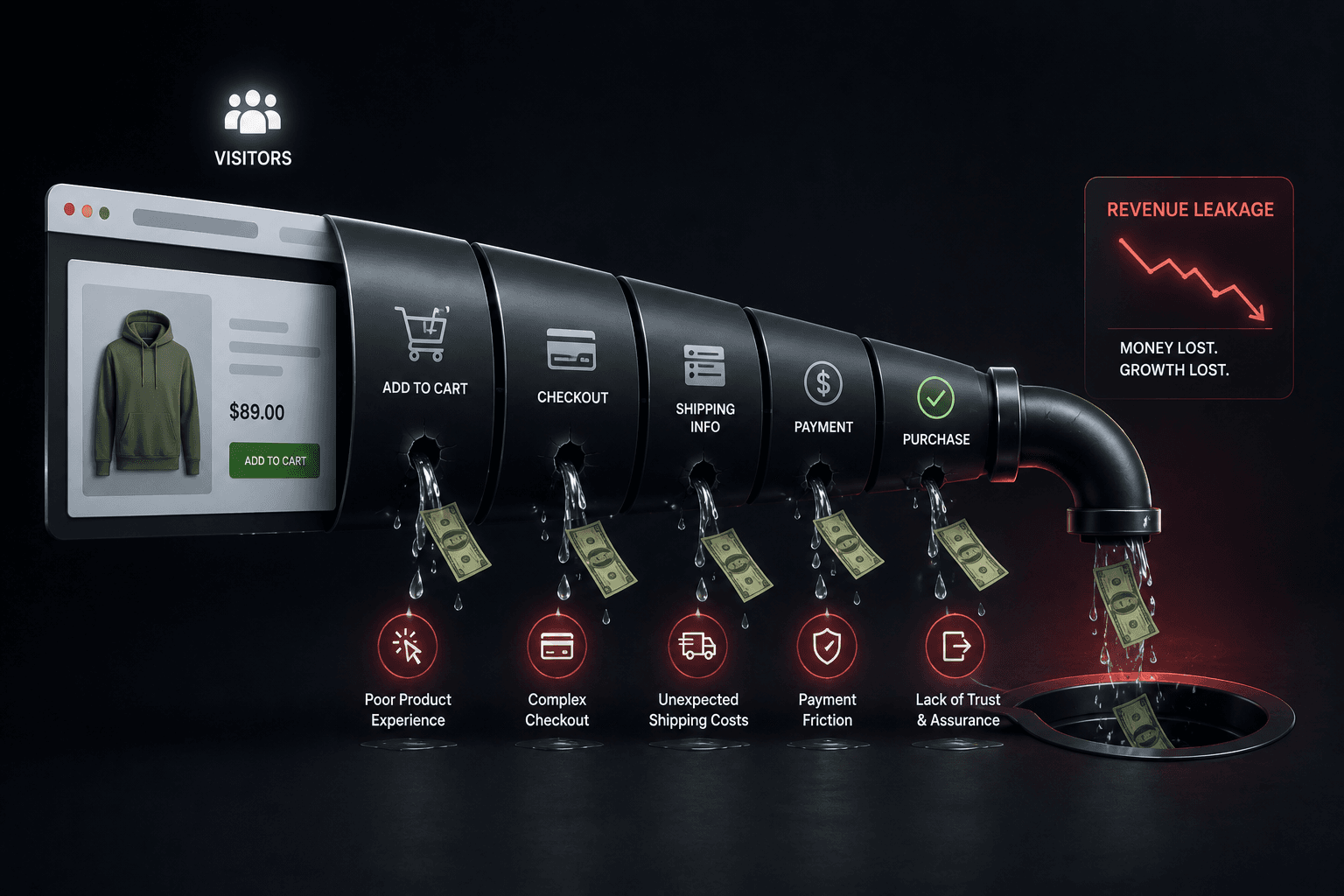
Revenue leakage ecommerce stores experience refers to the specific, quantifiable points where money is lost that a surface-level look at total sales won’t reveal.
Revenue leakage in ecommerce refers to the specific, quantifiable points where a store loses money that a surface-level look at total sales won’t reveal.
Revenue leakage refers to the specific, quantifiable points where a store loses money that a surface-level look at total sales won’t reveal. Cart abandonment is the most talked-about form, but it’s far from the only one.
Revenue leakage ecommerce stores rarely notice: the leaks beyond cart abandonment
- Product page bounce before add-to-cart. If a product page gets strong traffic but a low add-to-cart rate, the leak is happening before checkout even enters the picture, often missed because attention defaults to checkout-stage metrics.
- Failed payment attempts. A declined card or a timeout error that isn’t clearly communicated often results in a lost sale rather than a retry, worth checking your payment failure messaging specifically.
- Out-of-stock without a waitlist. Traffic to a sold-out product page with no restock notification captures zero future value from otherwise-interested visitors.
- Slow page speed on high-traffic pages. Even a one-second delay on your highest-traffic product pages compounds across volume in a way that’s easy to underestimate.
Why these are easy to miss
Standard analytics dashboards report conversion rate as one aggregate number. That number doesn’t tell you whether the leak is at the top of the funnel (traffic quality, product page) or the bottom (checkout, payment). Diagnosing revenue leakage requires looking at the funnel stage by stage, not just the final conversion percentage.
Pricing the leak, not just identifying it
Knowing a leak exists is step one, knowing what it’s actually costing in dollars is what makes prioritization possible. A small percentage improvement on a high-traffic page can outweigh a large percentage improvement on a low-traffic one.
Finding leaks continuously
Revvy identifies these leaks funnel-stage by funnel-stage and prices what each is costing in revenue terms, rather than surfacing a single aggregate conversion number. See how it works.
Small, consistent leak-checking habits, done by whoever already owns the store day-to-day, tend to outperform infrequent deep audits run by an outside party unfamiliar with the store’s specific history and quirks.
The stores that manage this well tend to build a simple, repeatable review habit rather than a one-time deep investigation. A lighter, more frequent check tends to catch leaks earlier and cheaper than an infrequent but exhaustive audit that only happens once a year.
Treat leak-finding as a continuous practice rather than a single audit. New leaks emerge as your store, catalog, and traffic evolve, the stores that stay ahead of this are the ones checking regularly, not the ones who did one thorough pass and assumed it would stay accurate indefinitely.
Assigning ownership for leak monitoring
Revenue leakage often falls into a gap between teams, marketing owns traffic, product owns the catalog, nobody explicitly owns funnel-stage leakage. Assign clear ownership, even if it’s a shared responsibility, so leaks get caught and prioritized rather than falling through organizational cracks.
Where to start if you’ve never audited for leakage
Begin with checkout and payment failures, they’re the closest point to a completed sale, so fixes here tend to show the fastest, most measurable revenue recovery before moving further up the funnel to product-page and browsing-stage leaks.
Leakage from abandoned browsing sessions with high intent
Not all leakage happens at cart or checkout, a visitor who views the same product multiple times across sessions without ever adding to cart is showing clear intent that’s going unaddressed. Retargeting or on-site prompts specifically for this behavior pattern (rather than generic retargeting for any site visitor) tend to recover a disproportionate share of otherwise-lost revenue.
Auditing customer support interactions for leakage signals
Support tickets and pre-sale chat inquiries often reveal revenue leakage that analytics alone won’t show, repeated questions about a specific product’s sizing, for instance, point directly to a product-page information gap costing sales before a customer ever reaches checkout.
Leakage from discount code misuse
Publicly shared or easily guessable discount codes can quietly erode margin without a corresponding increase in genuine new-customer acquisition, worth auditing how many discount code uses come from your intended audience (email subscribers, first-time visitors) versus general public code-sharing sites.
Currency and international pricing leakage
For international stores, static pricing not adjusted for currency fluctuation or region-specific willingness to pay can leave revenue on the table in some markets while pricing out otherwise-interested buyers in others. A periodic pricing review by region catches this kind of leak that purely funnel-focused audits miss.
Building a simple revenue leakage audit
Start by mapping your funnel into stages with a conversion rate at each: sessions to product view, product view to add-to-cart, add-to-cart to checkout start, checkout start to purchase. Whichever stage has the steepest relative drop-off (not necessarily the largest raw number) is usually where the biggest leak sits.
Leaks specific to subscription and repeat-purchase models
For subscription or repeat-purchase businesses, churn and failed payment retries on recurring charges are a form of revenue leakage separate from first-purchase conversion, worth auditing separately, since the fixes (dunning email sequences, card-update reminders) are different from front-funnel CRO tactics.
Common questions about revenue leakage
How often should I audit for revenue leakage?
Quarterly at minimum for most stores, more frequently during periods of rapid catalog or traffic growth when new leaks are more likely to emerge unnoticed.
See what Revvy finds in your own store, no card required.
Is revenue leakage the same as cart abandonment?
No, cart abandonment is one specific, well-known leak. Revenue leakage is the broader category covering every point in the funnel where money is lost, including several that get far less attention.
Can small leaks really add up to meaningful revenue?
Yes, particularly on high-traffic pages. A 1% improvement on a page seeing significant volume can outweigh a much larger percentage improvement on a low-traffic page.
Baymard Institute’s research documents checkout-stage leakage specifically in detail, one of several leak points covered here.
Finding revenue leakage in ecommerce is an ongoing practice, not a single audit you complete once.
Every category of revenue leakage ecommerce stores face compounds the longer it goes unaddressed.
Related reading
- The Ecommerce CRO Checklist: Product Page to Checkout
- Post-Purchase Upsells: How to Increase AOV Without Hurting Conversion
- Site Speed and Conversion Rate: How Much Milliseconds Actually Cost You
See what your leaks are actually costing.
Revvy prices each friction point in revenue terms, not just percentage lift.