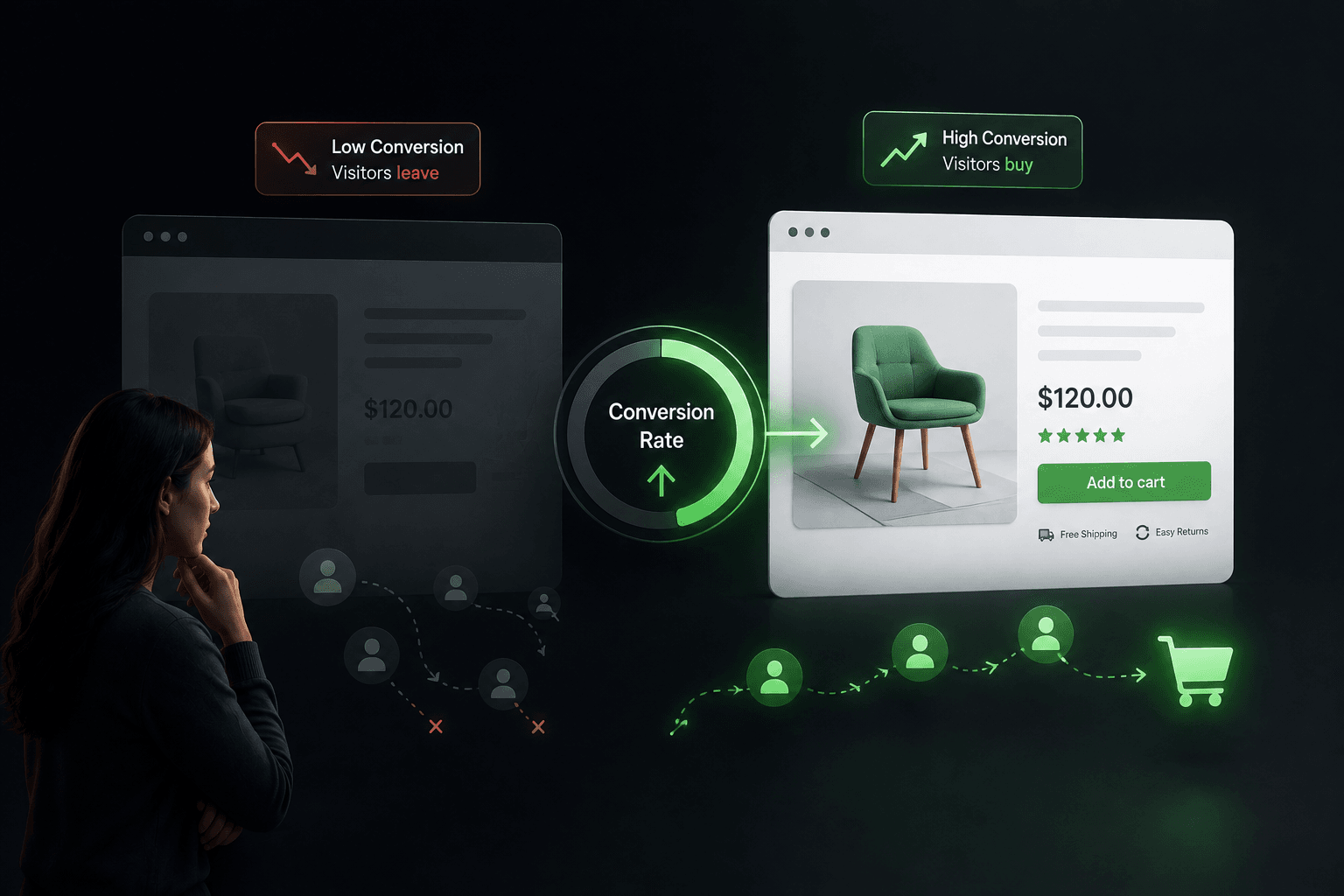
If you’re asking what is conversion rate optimization, here’s the short answer: it’s the practice of increasing the percentage of visitors who complete a purchase, without spending more on traffic.
Conversion rate optimization, or CRO, is the practice of increasing the percentage of visitors to your store who complete a specific action, usually a purchase. If 100 people visit your product page and 2 buy, your conversion rate is 2%. CRO is everything you do to move that number up without spending more on traffic.
What is conversion rate optimization actually measuring?
Most stores respond to slow sales by buying more ads. That works, but it’s expensive, and it doesn’t fix the underlying problem: if your store converts at 1.4% instead of 3%, you’re paying roughly twice as much for every sale. According to Shopify’s own CRO guide, the most effective conversion improvements come from reducing friction and increasing clarity, not from driving more people into a broken funnel.
How conversion rate is calculated
The formula is simple: completed purchases divided by total sessions, multiplied by 100. But most stores stop at that one number, when the real insight comes from breaking it into stages, product view, add to cart, checkout started, purchase. Each stage tells you something different about where visitors are losing confidence.
What CRO is not
CRO isn’t just changing a button color, and it isn’t the same thing as running an A/B test. A/B testing is one tool used inside CRO, not the whole discipline. Real CRO work touches navigation, product page content, checkout flow, and trust signals, tested against real data rather than assumed “best practices.”
Where to start
If you’re new to this, start by mapping your funnel stage by stage and finding the biggest drop-off point. Our guide to improving Shopify conversion rate walks through the most common friction points in order of impact.
None of this requires a large team or budget to start. A single person spending a few focused hours a month reviewing funnel data and shipping one fix at a time will outperform a store doing nothing at all. The discipline of consistent small improvement matters more than the size of any individual change.
A note on realistic timelines
Don’t expect dramatic overnight results from CRO work, even well-executed fixes typically take several weeks to show their full effect as enough traffic passes through the updated funnel to produce reliable data. Stores expecting a same-week revenue jump often abandon genuinely good changes too early, before the data has had time to accumulate.
Getting your first CRO win
If you’re just starting out, resist the urge to test something small and cosmetic first. Pick the funnel stage with the steepest drop-off, fix the most obvious friction there using documented best practices rather than a guess, and measure the result over a full month before moving to the next stage. That single disciplined pass typically outperforms scattered, untested changes across the whole site.
How CRO fits alongside SEO and paid media in a marketing plan
SEO and paid media are responsible for getting people to your site. CRO is responsible for what happens once they arrive. Treating these as separate budgets managed by separate people often means acquisition teams optimize for traffic volume while nobody owns what that traffic actually does once it lands. A gap that shows up directly in wasted ad spend. The stores that get the most out of every marketing dollar treat CRO as a shared responsibility across acquisition and product teams, not a standalone project handed to one specialist in isolation.
Signs your store needs CRO attention now
A few reliable signals: traffic is growing but revenue isn’t growing proportionally, your add-to-cart rate looks healthy but checkout completion lags, or your conversion rate has been flat for several months despite marketing changes. Any of these point to funnel-level friction rather than a traffic or product problem, which is exactly the kind of issue CRO work is built to find.
A worked example
Take a store with 10,000 monthly sessions, a 1.8% conversion rate, and a $65 average order value, that’s $11,700 in monthly revenue. Moving conversion rate to 2.4% (a realistic target after fixing checkout friction and product page trust signals) with no change in traffic or AOV produces $15,600, a 33% revenue increase without spending a dollar more on acquisition. This is the core argument for prioritizing CRO alongside, not instead of, traffic growth.
The relationship between CRO and paid acquisition
A higher conversion rate directly lowers your effective customer acquisition cost, since the same ad spend now produces more customers from the same traffic volume. This is why CRO and paid media teams benefit from coordinating, a landing page redesign that improves conversion effectively makes every existing ad campaign more efficient overnight.
Common CRO metrics beyond conversion rate itself
Conversion rate alone doesn’t tell the whole story. Add-to-cart rate shows whether product pages are compelling enough to generate intent. Checkout completion rate isolates whether intent actually turns into a sale. Average order value, tracked alongside conversion rate, prevents a common mistake, chasing a higher conversion rate with aggressive discounting that quietly erodes margin. A healthy CRO practice watches all of these together, not conversion rate in isolation.
Common questions about CRO
How long does CRO take to show results?
Structural fixes, checkout friction, missing trust signals, can show impact within days of shipping. Statistically valid A/B tests take longer, typically several weeks, since they need enough traffic to reach significance.
See what Revvy finds in your own store, no card required.
Do I need a certain amount of traffic to do CRO?
Formal A/B testing benefits from higher traffic to reach significance quickly. But fixing obvious structural friction, a confusing checkout, missing shipping info, doesn’t require a large sample to be worth doing.
Is CRO a one-time project or ongoing work?
Ongoing. New products, new traffic sources, and seasonal shifts all introduce new friction over time, which is why treating CRO as a single project tends to produce results that fade.
Getting conversion rate optimization right is less about any single trick and more about consistent, funnel-wide attention.
Understanding what is conversion rate optimization at a basic level is the foundation everything else here builds on.
Related reading
- The Ecommerce CRO Checklist: Product Page to Checkout
- Best CRO Tools for Ecommerce in 2026
- How Much Does CRO Cost? A Pricing Breakdown
See it find friction on your own store.
Revvy scans your funnel and ships the fix. No manual audit required. $12 free capacity, no card.