You are driving traffic to your Shopify store but no sales. That is a common problem for ecommerce brands across North West England. Stores invest in SEO, Meta ads, Google Shopping, influencer campaigns, and email, yet conversion still underperforms.
In most cases, the issue is not demand. It is decision friction.
That is why Shopify CRO in North West England has become more important than “getting more clicks.” Smart brands are now using AI to identify exactly where shoppers hesitate, where trust drops, and where the buying journey quietly breaks.
Discover where visitors are dropping off and why in minutes.
Pro Tip:
Spend less time guessing what hurts conversions and more time growing revenue with clearer store insights
Why Shopify CRO in North West England Matters More Than More Traffic
For serious ecommerce teams, growth is no longer just about traffic acquisition. It is about revenue efficiency.
If your product pages are getting visits and your store is adding to cart, but sales are not scaling at the same pace, the problem usually sits in one of these areas:
- weak product-page decision architecture
- low mobile buying confidence
- cart-to-checkout drop-off
- checkout friction that kills high-intent sessions
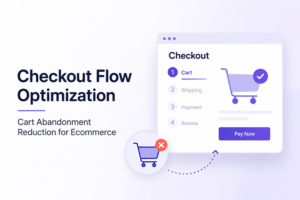
This is not theory. Baymard’s latest ecommerce checkout benchmark shows 70.19% of online carts are abandoned, and 64% of desktop sites plus 63% of mobile sites still perform at a mediocre or worse checkout UX level. Their research also estimates the average large ecommerce site could improve conversion by as much as 35% through better checkout UX.
That means many North West England Shopify stores are not losing because they lack visitors. They are losing because their funnel is leaking value.
The Shift From “Best Practice CRO” to Technical CRO
A lot of CRO advice online is too basic for serious brands.
You already know to improve trust badges, tighten copy, and speed up pages. That is entry-level.
Advanced Shopify CRO in North West England focuses on how the funnel behaves as a system.
1) Traffic intent mismatch
Not all traffic should land on the same page type.
If paid social traffic is landing on a product page built for branded search users, conversion will suffer. Cold traffic usually needs stronger visual proof, clearer use cases, and faster objection handling. Branded or returning traffic often needs less persuasion and more purchase efficiency.
This is why your landing structure must match session intent, not just keywords.
2) Product page decision sequencing
A lot of product pages are designed for browsing, not buying.
High-converting pages answer buyer questions in the right order:
- What is this?
- Why should I trust it?
- Why should I buy now?
- What happens after purchase?
If those answers are buried too low or scattered badly across the page, the shopper may still add to cart but not feel ready to buy.
Instead of relying on broad CRO assumptions, use Eulav AI agent to identify structural blockers such as poor hierarchy, weak CTA visibility, low trust reinforcement, and cluttered conversion paths.
See what Revvy finds in your own store, no card required.
3) Checkout friction hidden inside “working” flows
A checkout can technically function and still lose money.
This usually happens when:
- Guest checkout is not obvious
- Mobile form completion feels slow
- Wallet options are weak or poorly surfaced
- Shipping clarity appears too late
- Validation errors create interruption
Baymard’s checkout benchmark shows most ecommerce checkouts still leave major room for improvement, especially on mobile.
Where AI Actually Improves Conversion Performance
The value of AI is not “automation.”
The real value is pattern recognition at scale.
For larger Shopify stores, problems often repeat across multiple templates, collections, devices, and traffic sources. Manual audits can catch some of this. AI helps you surface the patterns faster.
For example, AI agent can help teams identify:
- where mobile users hesitate before clicking CTA
- where cart confidence drops before checkout
- which page structures create low buying readiness
- which friction points are reducing conversion efficiency
That matters because not all conversion problems deserve equal priority. Smart growth comes from fixing the highest-revenue blockers first.
FAQs: Shopify CRO in North West England: How AI Is Helping Local Stores Convert Smarter
Shopify CRO means conversion rate optimization for Shopify stores. It focuses on turning more visitors into buyers without increasing traffic spend.
Usually because of friction between landing pages, product pages, cart, and checkout. The traffic may be good, but the buying path is not efficient enough.
AI helps identify patterns humans often miss across templates, devices, and user behavior. That makes it easier to find what is actually reducing sales.
Yes. For stores already spending on acquisition, CRO often gives better ROI than simply buying more traffic.