
You built a great product, ran the ads, drove traffic, and yet the sales just are not where they should be. Checkout abandonment is high, product pages are getting views but no conversions, and you cannot figure out why. This is the silent revenue problem that kills thousands of ecommerce brands every year. The issue is rarely the product. Most of the time, it is buried inside the store itself, in the friction points, weak copy, poor page structure, and missed conversion signals that most store owners never even think to check.
That is where an AI-powered approach to store auditing changes everything. Instead of guessing or running expensive A/B tests for months, you now have tools that pull from a broad ecommerce brand database to benchmark your store against real performance data, flag exactly what is broken, and tell you what to fix first.
What an Ecommerce Brand Database Actually Does for Your Store
Most store owners think an audit means checking your page speed or making sure your checkout button is the right color. That is surface-level thinking. A real ecommerce brand database goes much deeper. It maps your store’s structure, product page behavior, conversion funnel drop-off points, and user experience signals against thousands of other ecommerce stores in similar categories.
The result is not a generic checklist. It is a specific, ranked list of the exact issues dragging your revenue down, ordered by the size of impact they are likely having on your bottom line. This kind of prioritized insight is what separates brands that scale from brands that stay stuck.
The Revenue Leaks Most Brands Never Find on Their Own
There are conversion problems hiding in almost every ecommerce store right now. Here are the ones that tend to cost the most money and go unnoticed the longest:
- Weak above-the-fold product page structure that fails to build trust before the user scrolls
- Misaligned offer framing where the value proposition does not match what the customer is actually searching for
- Checkout friction caused by unexpected costs appearing too late in the buying process
- Poor mobile UX patterns that look fine on desktop but silently kill conversions on phones
How AI-Powered Store Audits Go Beyond Standard CRO
Traditional conversion rate optimization (CRO) is slow. You form a hypothesis, set up a test, wait weeks for statistical significance, and maybe get a 2 to 3 percent lift. Larger brands with dedicated CRO teams can run dozens of tests in parallel. Smaller and mid-sized brands usually cannot.
AI changes this dynamic completely. When an AI-powered platform is trained on a deep ecommerce brand database, it can identify patterns that would take a human analyst weeks to find.
- It recognizes which product page layouts historically convert better for specific product categories.
- It knows which trust signals matter most at each stage of the buying journey.
- It can flag technical issues that are suppressing your SEO-driven traffic before it even reaches your conversion funnel.
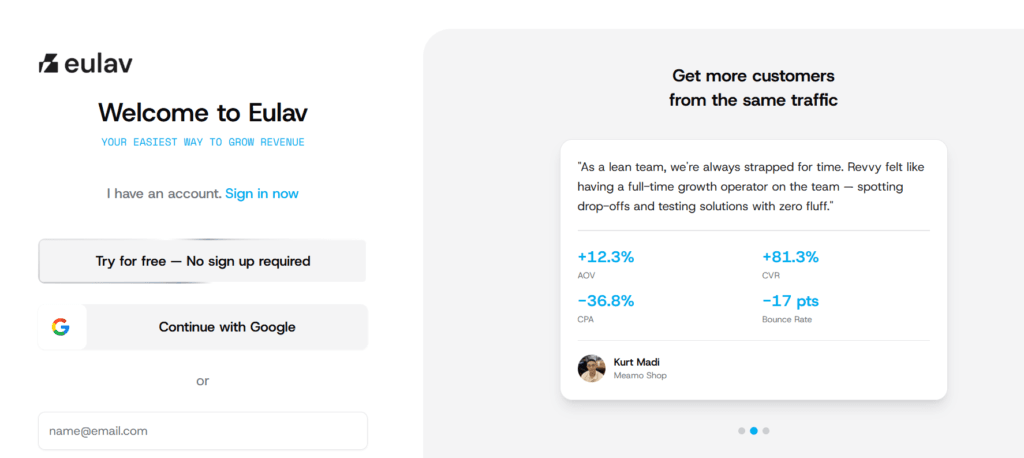
Try Eulav. It is built specifically for this kind of deep store analysis. It does not just scan your store and hand you a report full of jargon. It audits your store end-to-end, maps the friction points across your entire funnel, and delivers a prioritized fix list with clear explanations of why each issue is costing you money. For brands serious about scaling, this is a fundamentally different way to approach ecommerce growth.
How to Use an Ecommerce Brand Database to Prioritize Fixes
Not every fix is equal. One of the most common mistakes brands make after any audit is trying to fix everything at once. That leads to slow execution and diluted results. The smarter move is to use the data to stack-rank your issues by revenue impact and implementation speed.
A good framework for working through audit findings looks like this:
- Fix high-impact, low-effort issues immediately (these are usually copy and layout changes)
- Schedule medium-effort fixes with clear owners and deadlines within 30 days
- Build a roadmap for structural or technical changes that require development resources
This approach, informed by real ecommerce brand database benchmarks, lets you capture quick wins while building toward bigger structural improvements. You can read more about conversion rate strategies for ecommerce brands to see how this plays out across different store types.
The Cost of Waiting
Every week you run your store without fixing the conversion leaks is a week of lost revenue. If your store converts at 2 percent and you are getting 50,000 monthly visitors, moving to 2.5 percent conversion rate adds 250 extra sales per month. At a $100 average order value, that is $25,000 in additional monthly revenue from fixing issues your store already has.
The traffic is already there. The product is already there. The gap is almost always in the store experience itself.
Start With a Store Audit, Not More Ad Spend
The instinct when sales slow down is to spend more on ads or try a new channel. But sending more traffic to a leaky funnel just accelerates the losses. The smarter move is to fix the store first.
Eulav gives you a clear, actionable picture of exactly what is holding your store back, based on real ecommerce brand database benchmarks, not guesswork. If you are ready to stop wondering why your numbers are not moving and start knowing exactly what to fix, an AI-powered store audit is the fastest path forward.
FAQs: Ecommerce Brand Database: AI-Powered Store Audits That Show You Exactly What to Fix
It is a collection of performance data, behavioral patterns, and conversion benchmarks from ecommerce stores across different categories. AI tools use this data to compare your store against real market standards and identify specific weaknesses.
AI-powered platforms analyze your store’s funnel, page structure, copy, and UX against patterns from thousands of other stores. They flag the exact points where customers drop off and explain what is likely causing each issue.
See what Eulav finds in your own store. Start with free opportunity finding and 2 tests.
For most mid-sized brands, yes. An AI audit delivers faster results at a fraction of the cost, and tools like Eulav are specifically built around revenue impact, not just technical fixes.
At minimum, after any major change to your site, after a traffic spike or drop, and at least once per quarter as part of ongoing performance management.
Where Eulav fits
Make the most of every visit and see a measurable lift in your first 30 days, or get a refund. Eulav is an AI-powered revenue optimisation platform for ecommerce brands, including Shopify stores, built by a team with over a decade in DTC revenue optimisation. It scans your store, shows where you can sell more, including any hidden blockers, and measures each optimisation you approve. Each optimisation is shown to some of your visitors first, and nothing goes live without your approval.
Spending on traffic? Whether a visit came from paid, organic or email, Eulav helps it convert, so your traffic spend earns more. At 1,000 visits, lifting conversion from 2% to 2.5% turns 20 orders into 25, with no extra ad spend.
Built for your category: Shopify CRO for fashion, beauty, supplement, jewellery, footwear brands. Comparing tools? See alternatives to Intelligems, Shoplift, Hotjar, Convert.
Make the most of the traffic you already invest in. Start with free opportunity finding and 2 optimisations. No card, 60-second setup.