You are paying for traffic, running ads, posting on social media, and doing everything the gurus say, yet your BigCommerce store is still converting at a fraction of what it should. Sound familiar? Most store owners assume the problem is not enough traffic. The truth is far more painful: the traffic is there, but something on your store is quietly killing every sale before it happens.
The good news is that this is a fixable problem. Tools like Eulav audit your store, find exactly what is killing sales, and show you what to fix, often surfacing revenue leaks in minutes rather than months. But before you reach for any tool, you need to understand what conversion rate optimization (CRO) actually means for a BigCommerce store and where the biggest opportunities hide.
If your store is getting traffic but not sales, every day you wait costs you revenue. Run a store audit with and get a clear list of exactly what to fix
Why Your BigCommerce Conversion Rate Is Probably Lower Than You Think
The average ecommerce conversion rate hovers around 1.89% as of 2024. That means for every 100 visitors your store attracts, fewer than two actually buy. And yet most store owners never look at this number until something goes seriously wrong.
What makes this worse is that 70.32% of online shoppers abandon their carts before completing a purchase. You have already won the hard part, getting someone to add a product to their cart, and then you lose them. That is not a traffic problem. That is a conversion problem, and it is sitting inside your store right now.
The most common culprits are not dramatic. They are small friction points: a checkout form with too many fields, a product page with no social proof, a slow-loading image on mobile, a shipping cost that only appears at the final step. Each one, on its own, costs you a handful of sales. Together, they can cut your revenue in half.
To understand how to fix them, it helps to look at what top-performing stores are doing differently. One BigCommerce merchant reported an 83% increase in revenue and a 71% increase in conversion rate after systematically addressing these issues. That is not magic. That is what happens when you stop guessing and start optimizing with data.
How to Optimize Your BigCommerce Product Pages for Higher Conversions
The Product Page Is Your Digital Sales Floor
If a customer lands on a product page and leaves without buying, you have a conversion problem at its most fundamental level. BigCommerce product page optimization is not about cosmetic redesigns. It is about removing every reason a shopper might hesitate.
The three highest-impact changes you can make to a product page are:
- Social proof above the fold. Ratings, review counts, and trust badges should appear before a user scrolls. Shoppers who see reviews before engaging with a product are significantly more likely to convert.
- High-quality images with zoom and multiple angles. Online shoppers cannot touch the product. Images do the heavy lifting. BigCommerce’s built-in media tools support multiple product photos, but most stores only use one or two.
- Benefit-driven copy, not feature lists. Instead of listing specs, answer the question the customer is already asking: what will this do for me?
BigCommerce’s own product page analytics reveal something useful here. Their Products to Improve report surfaces your top-visited products with below-average conversion rates. These are the pages leaking the most revenue, and they are hiding in plain sight in your dashboard.
For more on turning visitors into buyers through better content strategy, see our guide on ecommerce content strategies that drive revenue.
Fixing Cart Abandonment: The Fastest Revenue Recovery in Ecommerce
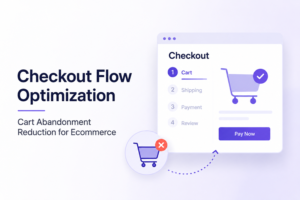
Cart abandonment is not a new problem, but it is getting more expensive to ignore. With cart abandonment rates sitting above 70% industry-wide, recovering even a fraction of those lost carts has a direct impact on revenue without spending an extra dollar on advertising.
What Actually Causes Shoppers to Leave at Checkout
Surprise costs top the list. When a shopper sees a $49 item and then watches the total jump to $68 at checkout due to shipping and taxes appearing for the first time, they leave. Not because they are cheap, but because they feel misled. Displaying estimated shipping costs early in the shopping journey is one of the simplest and highest-ROI changes a BigCommerce store can make.
Payment friction is the second major driver. Research shows that adding PayPal to a checkout lifts completion rates to nearly 59%, and offering both PayPal and Apple Pay pushes that figure to around 62%. Wallet payments work because they eliminate form-filling entirely. For mobile users, this difference is enormous.
MUJI, a global BigCommerce merchant, grew 50% year over year after modernizing its storefront with faster performance, a mobile-first design, and flexible payment options. That kind of result does not come from a single tweak. It comes from addressing the full checkout experience as a system.
Beyond checkout, BigCommerce’s built-in Abandoned Cart Saver, paired with email tools like Klaviyo, can recover up to 15% of abandoned sessions through well-timed follow-ups. A simple email with the product image and a modest incentive, sent within an hour, often does the job.
For a deeper dive into how email sequences can support your CRO work, explore our post on email marketing strategies for ecommerce stores.
Your Checkout Is Losing You Sales Right Now.
Scans your store in minutes. Find the exact checkout friction points costing you conversions, with clear fixes you can implement today.
Mobile Optimization: The CRO Gap Most BigCommerce Stores Are Ignoring
Mobile commerce now accounts for over 60% of ecommerce sales globally. Yet mobile conversion rates consistently lag behind desktop by a wide margin. The reason is almost always speed and form friction.
BigCommerce’s own data shows that a slow-loading page can tank conversion rates by up to 7%. On mobile, where attention spans are shorter and patience for loading is thinner, the cost is even higher. Stores targeting less than two seconds for core page loads see noticeably better engagement and conversion numbers.
One practical case: a specialty retailer that switched to a mobile-optimized theme and compressed product images saw a 15% drop in bounce rate and a 10% lift in conversions within weeks of the change. No new products. No new ads. Just a faster, cleaner mobile experience.
On the checkout side, digital wallets like Apple Pay and Google Pay essentially eliminate the mobile form problem. When a shopper can check out with Face ID instead of typing a 16-digit card number on a small screen, drop-off plummets. Amazon Pay is showing similar results, with merchants reporting around a 25% lift in conversions after adding it, driven by the trust and speed Prime shoppers associate with the badge.
See what Revvy finds in your own store, no card required.
Our article on improving your store’s page speed and technical performance breaks down the specific technical fixes that have the highest CRO impact for BigCommerce stores.
A/B Testing and Data-Driven CRO: How the Best BigCommerce Stores Keep Improving
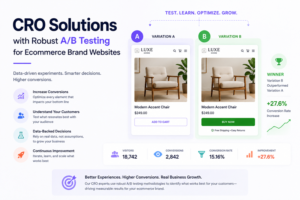
One of the most reliable ways to improve your BigCommerce conversion rate is to stop relying on best practices alone and start running your own tests. A/B testing lets you compare two versions of a page element and know, with statistical confidence, which one drives more sales.
What to Test First for Maximum Impact
The highest-leverage A/B tests for BigCommerce stores typically involve:
- CTA button text and color. “Add to Cart” versus “Get Yours Today” can make a measurable difference, especially on high-intent product pages.
- Product description format. Paragraph copy versus scannable bullet points converts differently depending on the product type and audience.
- Trust signal placement. Moving a review widget or a money-back guarantee badge above the fold versus below it can shift conversion rates noticeably.
Businesses that invest in conversion rate optimization tools see an average ROI of 223%. That figure puts CRO spending in a category where the question is not whether to invest, but where to start.
The challenge for most store owners is not lack of willingness to test. It is not knowing which elements are worth testing first. That is where a proper store audit pays for itself. Rather than running random experiments, you work from a prioritized list of high-impact issues, which means every test moves the needle faster.
To understand how to build a sustainable testing culture into your store operations, read our post on building a data-driven ecommerce growth strategy.
FAQs About BigCommerce CRO
The ecommerce average sits around 1.89% to 2.7%, but top-performing stores in certain categories reach 4% or higher. Rather than chasing a benchmark, focus on improving your own rate consistently over time. Even a 0.5% improvement on a store doing $200,000 a month in revenue translates to real money.
Some fixes, like adding a payment method, reducing checkout steps, or surfacing shipping costs earlier, can show results within days. Others, like A/B testing a product page layout, require enough traffic to reach statistical significance, which can take two to four weeks depending on your traffic volume.
Not necessarily. Many of the highest-impact CRO changes involve content, copy, image quality, and checkout settings that any store owner can manage within the BigCommerce dashboard. The bigger need is knowing where to look, which is why a structured audit process matters more than technical skills at the start.
Treating it as a one-time project. Conversion optimization is an ongoing process because customer behavior evolves, seasonality affects intent, and competitors raise the bar. Stores that build a habit of monthly review and testing consistently outperform those that make one round of changes and move on.
The Bottom Line
Getting more traffic is expensive. Getting more from the traffic you already have is one of the smartest investments any ecommerce store owner can make. The stores winning on BigCommerce right now are not necessarily running bigger ad budgets. They are running tighter operations: faster pages, cleaner checkouts, stronger product pages, and a habit of testing and improving.
The strategies covered here, from product page improvements to mobile optimization to cart recovery, are not theoretical. They are backed by data from real stores and real behavior patterns. The question is which ones apply to your store most urgently, and in what order you should tackle them.
That is the exact problem Eulav solves. It audits your store, finds what is killing sales, and shows you exactly what to fix. No guesswork. No wasted experiments. Just a clear path to a higher conversion rate, starting today.
For more resources on growing your store, visit Eulav Insights for in-depth guides on ecommerce strategy, CRO, and sustainable growth.