Wondering how much does cro cost? It varies enormously depending on the model, and comparing options without understanding the structure behind each price tag makes it hard to judge what’s a good deal.
CRO pricing varies enormously depending on the model, and comparing options without understanding the structure behind each price tag makes it hard to judge what’s actually a good deal.
How much does CRO cost with a full-service agency?
Typically $2,000–$10,000+ per month, usually with a minimum contract length. You’re paying for a dedicated team running the full cycle, audit, testing, implementation, reporting. Makes sense for larger stores with the traffic volume to make frequent A/B testing statistically meaningful.
Independent consultants
A few hundred to a few thousand dollars per project, or an hourly/retainer rate for ongoing work. Cheaper than an agency, more variable in quality and availability since it depends on one person.
Self-serve CRO tools
Usually $50–$500+ per month depending on traffic tier, for analytics, heatmaps, or A/B testing software. Cheapest option on paper, but implementation and analysis time still falls on you or your team.
Pay-as-you-go autonomous agents
A newer model, Revvy runs on a pay-as-you-go basis with no subscription or contract, billed as optimization capacity that never expires. You pay for what gets used rather than a flat monthly retainer regardless of activity. Full breakdown on the pricing page.
How to think about ROI, not just cost
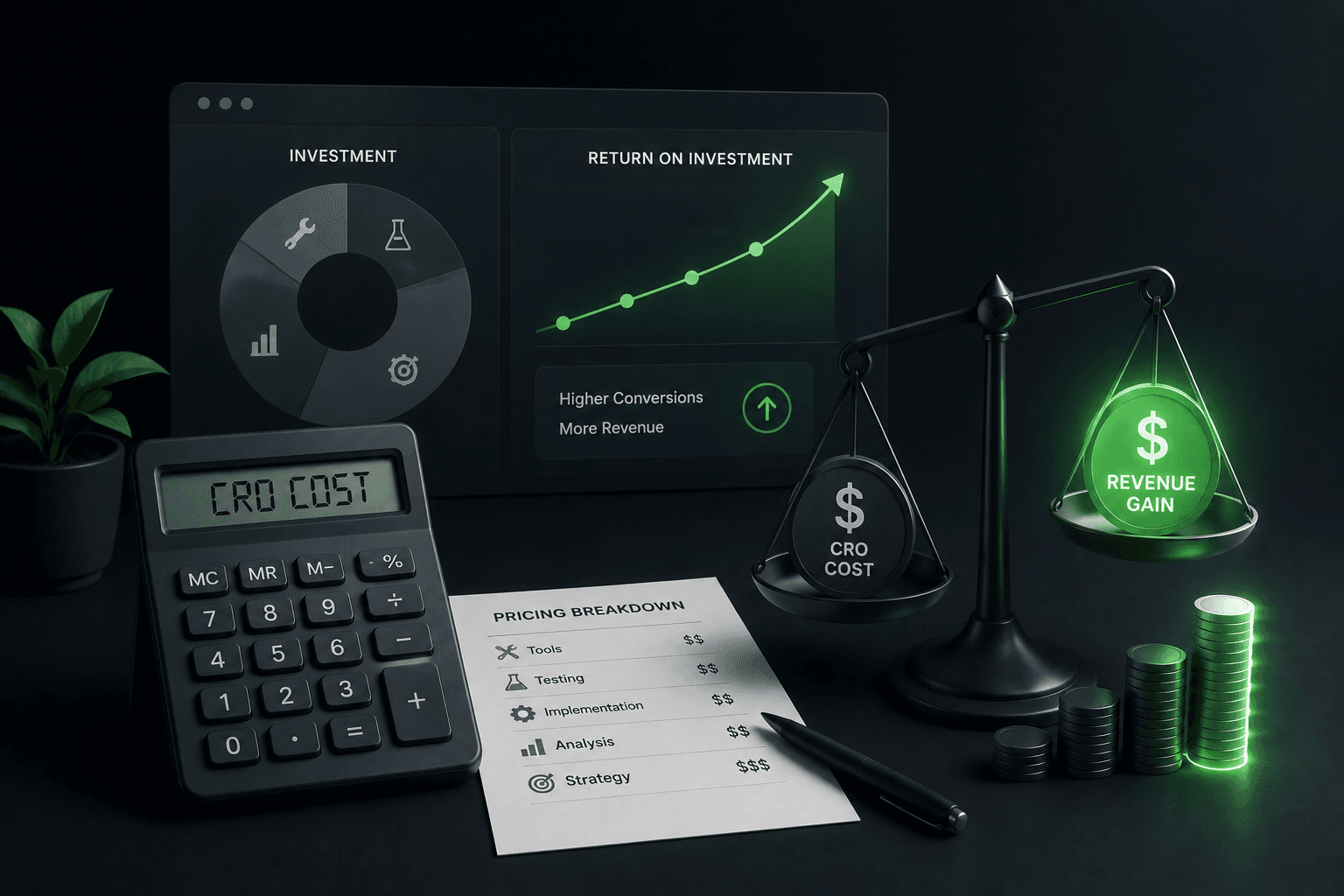
The right comparison isn’t monthly price. It’s cost relative to the revenue a fixed leak is worth. A $200/month tool that never gets properly implemented delivers worse ROI than a $2,000/month agency that ships real fixes. Ask what each option actually delivers in shipped changes, not just access to a dashboard.
Revisit your CRO budget alongside your broader marketing budget review, not as an isolated, separate decision, the two are more connected than they’re often treated as being.
Cost conversations are easier once you’ve done the work of understanding your own numbers first, your current conversion rate, your abandonment rate, your average order value. Walking into any pricing conversation with that context lets you evaluate any option against your actual situation, not just a vendor’s pitch.
Whatever you choose to spend, tie it to a clear, revisitable goal rather than an open-ended commitment. Set a checkpoint to evaluate results against that specific goal, and be willing to adjust, more budget, less budget, or a different model entirely, based on what the data actually shows.
Avoiding the sunk cost trap
If a CRO investment, agency, consultant, or tool, isn’t producing measurable results after a reasonable evaluation period, don’t keep paying simply because you’ve already invested. Set a clear evaluation checkpoint upfront so the decision to continue or stop is based on results, not inertia.
A simple way to start budgeting
Rather than picking a CRO budget in isolation, tie it to a specific, quantified problem. Your documented cart abandonment rate, your checkout drop-off percentage, and size your spend against what fixing that specific leak is realistically worth. This grounds the decision in your own numbers rather than an industry-wide rule of thumb.
Negotiating agency pricing realistically
Agency pricing is rarely as fixed as the initial quote suggests, asking about a shorter trial engagement, a reduced scope to start, or performance-based pricing tiers can open room for negotiation, particularly for agencies eager to add a case study from your specific industry or store size.
Calculating your own break-even point
Before committing to any CRO spend, calculate the conversion rate improvement needed to cover the cost. A $1,000/month tool needs to generate more than $1,000 in additional monthly profit to be worthwhile, which is a lower bar than it might initially seem once you factor in your actual margin and current traffic volume.
Cost comparison by store size
A store doing under $50k/month in revenue typically can’t justify a full agency retainer relative to the potential gains, self-serve tools or pay-as-you-go models fit better here. Stores above roughly $500k/month in revenue often find the ROI math clearly favors agency or dedicated in-house investment, since even small percentage improvements represent meaningful absolute revenue.
The cost of doing nothing
It’s worth explicitly calculating what unaddressed friction is currently costing before comparing tool or service prices in isolation. A store leaking 15% of potential revenue to preventable checkout abandonment has a much larger implicit “cost” than any CRO tool’s subscription price, which reframes the pricing conversation entirely.
Hidden costs beyond the headline price
A cheap tool with a high time cost to implement and interpret can end up more expensive in practice than a pricier tool that requires less manual work. Factor in the hours your team will spend using any option, not just its subscription or retainer fee.
Budgeting CRO relative to ad spend
A useful rule of thumb: if you’re spending significantly on paid traffic acquisition, a comparatively modest CRO budget improving conversion even slightly often delivers better ROI than the equivalent spent on more traffic into an unoptimized funnel.
See what Revvy finds in your own store, no card required.
Common questions about CRO pricing
Is free CRO tooling ever enough?
For basic analytics (Google Analytics, free heatmap tiers), yes for smaller stores just starting to look at behavior. Implementation and testing still typically require paid tooling or dedicated time.
How do I budget for CRO as a new store?
Start with the fundamentals checklist before paying for anything, a lot of early-stage friction is fixable at zero tool cost, just time.
What’s a reasonable CRO budget as a percentage of revenue?
Varies widely by stage and margin, but treating CRO spend as an investment against your checkout/cart abandonment rate specifically (not an arbitrary percentage) is a more grounded approach than a fixed rule of thumb.
Shopify’s tactics guide is a useful free reference to compare against before paying for any of the options above.
Whatever the number, understanding how much does cro cost relative to your actual leak size is what makes the decision easy.
Related reading
- Conversion Rate Optimization Agency: What to Actually Look For
- How to Hire a CRO Consultant for Ecommerce
- What Is an Autonomous CRO Agent?
See exactly what you’d pay.
$12 free capacity to start, no subscription, no contract, Revs never expire.