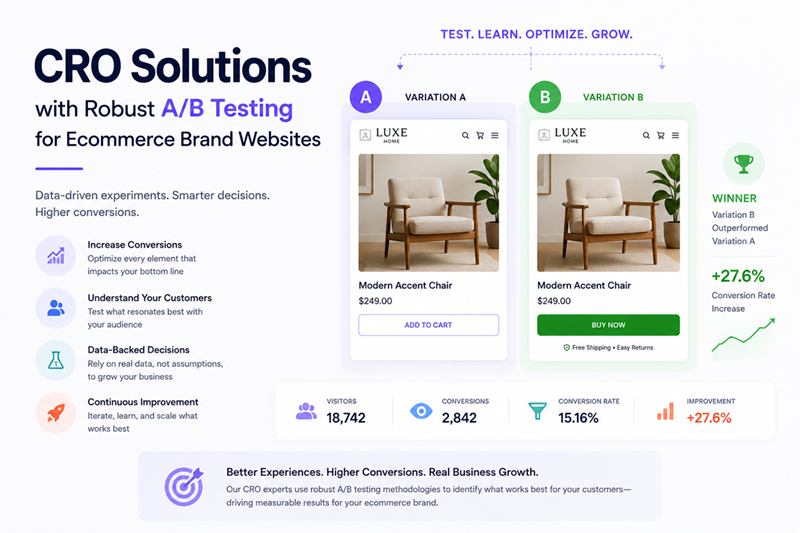
Most large brand websites are leaking revenue right now. Not because they lack traffic, but because the traffic they already own is not converting. Only 42% of businesses run A/B tests at least once per quarterand 58% of companies still make website changes based on opinions, not data. For brands spending millions on paid acquisition, that is a structural problem, not a tactics problem.
The fix is not to run more tests. The fix is to run smarter ones. Find and fix your conversion leaks in minutes
What Most CRO Programs Get Wrong
The biggest mistake enterprise teams make is treating A/B testing as a feature toggle rather than a revenue engine. They test button colors. They test copy. They declare a winner at 80% confidence and move on. The result: marginal lifts, high variance, and zero cumulative learning.
Here is what the data shows about high-performing programs:
- Brands running structured CRO programs see an average ROI of 223%.
- Companies that run CRO experiments monthly see an average 1.8x increase in annual revenue.
- Revenue-focused testing programs improve conversion performance by up to 40% while cutting wasted marketing spend by 50%.
The mechanism is compounding. Each winning test changes the baseline. The next test runs off an already-improved page. Over 12 months, a 2% monthly lift compounds to a 27% annual gain. Teams that run one-off tests never reach that curve.
What separates top-quartile performers is not budget. It is test velocity combined with statistical discipline. 71% of active testers run two or more tests per month, signaling a shift from one-off experiments to ongoing optimization programs.
The Technical Architecture of Robust A/B Testing
For large brand websites, flawed test architecture is the most common source of false positives. Here are the specific failure modes that cost conversion teams credibility with leadership:
Sample size miscalculation. Running a test to 80% confidence when your traffic volume demands 95%+ leads to rollouts that regress after 30 days. Research suggests at least 25,000 visitors is the sweet spot for reliable A/B test results. For brands with high-traffic pages, that threshold is reachable in days. For lower-traffic pages, you need a minimum detectable effect calculation before the test launches.
Novelty effect contamination. Returning visitors behave differently than new ones in the first 72 hours of a test. If you call a winner before the novelty effect washes out, you are measuring curiosity, not preference. Proper test architecture segments visitor type and weights accordingly.
Concurrent test interference. Running too many experiments simultaneously makes it difficult to determine what influenced the outcome. On large sites with multiple teams, test collision is a real problem. A proper CRO platform tracks test overlap and flags interaction effects before they corrupt your data.
Segment blindness. A test that wins overall can be losing badly for mobile users, new visitors, or a specific geographic segment. Winning at the aggregate level while losing in your highest-value segment is a common and costly mistake.
Revvy AI addresses all four of these failure modes inside a single experimentation layer, without requiring engineering resources for every test setup.
Where A/B Testing Drives the Most Lift for Large Brands
Not all pages convert equally, and not all tests are worth running. Based on benchmarked data, here is where the highest-leverage opportunities typically sit:
- Layout and UX redesigns produce the largest average lift at 18-40%, compared to headline tests (9%) or button color changes (6%).
- A well-designed UI can increase conversion rates by up to 200%, and an improved UX can increase conversions by up to 400%.
- Personalized CTAs convert 42% more visitors than generic ones.
- CTAs surrounded by white space can increase conversions by 232%.
- Reducing form fields from 7 to 3 increases conversions by 20-35%.
The pattern here is friction removal, not cosmetic change. Every test should have a clear hypothesis rooted in a friction point, not an aesthetic preference.
For a deeper breakdown of how funnel friction maps to test priority, see how AI approaches conversion funnel auditing for brand-scale websites.
AI-Powered Testing: Not Hype, Measurable Lift
Companies using AI-powered CRO tools report average conversion rate increases of 15-25%, with some platforms citing 20-30% uplifts over non-AI-optimized controls. The mechanism is not magic. AI accelerates three specific parts of the CRO workflow:
Test ideation. Pattern recognition across behavioral data surfaces friction points that manual analysis would miss. AI-assisted test ideation increases win rates by 23%.
See what Revvy finds in your own store, no card required.
Traffic allocation. Multi-armed bandit frameworks shift traffic dynamically toward the winning variant during a test, capturing revenue that traditional fixed-split testing leaves on the table.
Segment targeting. AI identifies the visitor segments where a variant outperforms, even when the aggregate result is neutral. This allows partial rollouts that unlock value from a “losing” test.
In 2025, 30% of companies used AI to improve testing and experimentation, up from roughly 5% in 2021. Brands that delay adoption are not just missing upside. They are falling behind competitors who are compounding AI-driven gains month over month.
Eulav AI agent integrates test prioritization with a full experimentation suite designed for brand-scale traffic volumes.
Why Brand Websites Need a Dedicated CRO Layer
Generic website platforms are not built for conversion optimization. They are built for content delivery. The gap matters because only 39.6% of companies have a fully documented CRO strategy. Without a dedicated layer, optimization becomes reactive, driven by whoever has the loudest opinion in the room.
A dedicated CRO solution like Eulav AI agent provides the infrastructure for systematic experimentation: hypothesis tracking, test documentation, statistical significance thresholds, segment reporting, and a learning repository that survives team turnover.
For more on building a systematic optimization program, read our guide to building a CRO strategy from audit to execution and our breakdown of conversion funnel mapping for enterprise brands.
FAQ: CRO Solutions with Robust A/B Testing for Brand Websites
At minimum, two to three concurrent tests on high-traffic pages. The goal is enough velocity to generate 12 or more winning tests per year. That requires a structured pipeline, not ad hoc requests.
For most brand websites, 95% confidence is the accepted threshold. At lower traffic volumes, 90% may be acceptable if paired with a longer test duration and a pre-defined minimum detectable effect.
AI accelerates test ideation by surfacing behavioral friction from session and heatmap data, dynamically reallocates traffic during live tests, and identifies segment-level winners that aggregate reporting would miss.
Start with checkout flows, pricing pages, and primary CTAs, as these carry the highest revenue impact per conversion point. Layout tests, not copy tweaks, drive the largest measurable lifts.