You are running paid ads. Your traffic numbers look healthy. But your revenue is barely moving. This is one of the most frustrating problems in ecommerce, and it is more common than you think. Most brands are stuck in a loop of buying more traffic instead of fixing what happens after the click.
The real issue is not volume. It is revenue per visitor (RPV), and it is the one metric that tells you how much money each person on your site is actually worth.
The good news is that RPV is fixable without spending more on ads. What it takes is a smarter approach to ecommerce conversion rate optimization (CRO), one that goes beyond basic tweaks and gets into the mechanics of how buyers actually behave.
Why Revenue Per Visitor Is the Metric That Actually Matters
Most ecommerce teams track conversion rate as their top KPI. That is fine, but conversion rate alone can be misleading. A store selling a $10 product at a 5% conversion rate earns $0.50 per visitor. A store selling a $200 product at a 1.5% conversion rate earns $3.00 per visitor. The second store wins every time.
RPV is a precise metric that ties value directly to each visitor. It is especially helpful for evaluating the quality of traffic, not just quantity.
When you combine it with average order value (AOV) and customer lifetime value (CLV), you get a much clearer picture of where your funnel is actually leaking money.
A store spending $50,000 per month on ads with a 2% conversion rate generates the same revenue as a store spending $25,000 per month with a 4% conversion rate. Same revenue, half the ad spend. That is the power of optimizing for RPV over raw traffic.
The Hidden Friction Points Hurting Your Revenue Per Visitor
Before you can improve RPV, you need to know where visitors are dropping off. Most teams jump straight to A/B testing without doing a proper friction audit first. That is a waste of time and budget.
Start with a session recording and heatmap review on your highest-traffic pages. Look for rage clicks, dead zones, and scroll depth patterns. Then layer in your funnel data from GA4 to identify the exact step where visitors stop moving forward. In most stores, the biggest drop happens in one of three places: the product page, the cart, or the checkout.
Data from 600-plus Shopify stores in 2026 found that 18.2% of shoppers cite pricing as the main hesitation, while 4.6% abandon due to shipping costs and 3.6% due to unclear discounts.
These are not conversion problems. They are communication problems. Your value proposition is not landing clearly enough at the moment the visitor needs it most.
One fix that consistently moves the needle: add above-the-fold value anchors on product pages. This means showing total savings, free shipping thresholds, and trust signals before the visitor has to scroll. Above-the-fold infographics drove a 6% higher conversion rate in recent testing, while sticky add-to-cart buttons boosted conversion by 5%. Small layout decisions compound fast when you are working at scale.
Advanced CRO Tactics That Move Revenue Per Visitor
1. Segment Your Traffic Before You Optimize
One of the most overlooked moves in CRO is segmenting visitors by traffic source before running any test. A visitor from a branded search behaves completely differently than one from a cold display ad. Optimizing one experience for both of them is like using the same sales pitch for a returning customer and a stranger.
Build separate landing experiences for your top three traffic segments. Use behavioral triggers to surface different offers based on entry point, device type, and session history. Ecommerce marketers can convert over 30% more visitors using AI-powered tools that surface the best content for the incoming user.
That kind of lift does not come from redesigning your homepage. It comes from showing the right message to the right person at the right time.
2. Fix the Checkout Before You Touch Anything Else
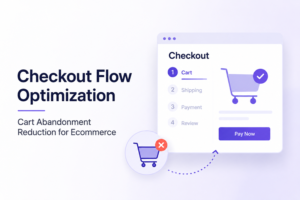
Cart abandonment is the most expensive leak in most ecommerce funnels. Single-page checkouts convert 21.8% better than two-step flows, according to ElasticPath testing. If your checkout is still multi-step, that is the first thing to fix.
Beyond layout, look at your payment options. In 2026, shoppers expect to see Apple Pay, Google Pay, and Buy Now Pay Later options at checkout. Forcing someone to type in card details when they are used to one-tap payments creates unnecessary friction that costs you sales.
See what Revvy finds in your own store, no card required.
3. Use Post-Purchase Flows to Lift AOV
Most brands treat the confirmation page as the end of the journey. Smart brands treat it as the beginning of the next one. Post-purchase upsell flows are one of the highest-converting placements in all of ecommerce because the buyer has already said yes once.
Post-add-to-cart upsell popups lifted average order value by 10%, while tiered pricing models increased AOV by up to 12%. You do not need to be aggressive about it. A simple “customers who bought this also loved” recommendation with a one-click add option is enough to move the needle without annoying your buyers.
4. Automate Personalization With AI
Manual personalization does not scale. If you are running a large ecommerce operation, you need systems that can adapt the shopping experience in real time based on individual behavior. This is where AI-powered CRO tools become essential.
Revvy AI is built specifically for this. It uses behavioral data to surface personalized offers, trigger contextual nudges at the right moment in the funnel, and run continuous experiments without requiring your team to manage every test manually. Instead of guessing what to test next, you get a system that learns from your traffic and improves RPV automatically over time.
How to Track Whether Your CRO Is Actually Working
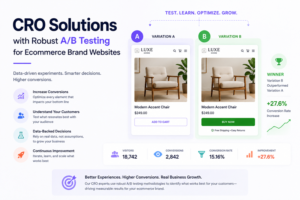
The biggest mistake brands make after running CRO experiments is declaring a winner too early. Industry consensus sets 95% confidence as the safety line for declaring winners. Use online calculators to estimate minimum detectable effect and required visitors. Under-powered tests produce false lifts.
Track RPV as your primary KPI, not just conversion rate. A test might lift conversion rate by 0.3% while dropping AOV by $8. That is a net loss, but most teams would call it a win if they are only watching one number. Always calculate the full revenue impact before you roll anything out sitewide.
Measure success by tracking conversion rate, revenue per visitor, bounce rate, and cart abandonment rate together. CRO is a continuous process, not a one-time fix.
FAQ: on Revenue Per Visitor: How to Improve It With Smart Ecommerce CRO
It depends on your product category and price point. A general benchmark is to know your AOV and multiply it by your conversion rate to get RPV. If your RPV is below $1.00 on a mid-range product catalog, there is almost certainly a friction issue somewhere in your funnel worth investigating.
CRO removes the barriers that stop visitors from converting and increases the average value of each transaction through better offer design, smarter upsells, and personalized experiences. The result is more revenue from the same amount of traffic.
Most well-structured A/B tests reach statistical significance within two to four weeks on moderate traffic volumes. Larger sites can run faster cycles. The key is running tests at the right confidence level and measuring full revenue impact, not just clicks.
Yes, but the priority should be fixing structural friction first, such as checkout flow, page speed, and trust signals, before running complex multivariate tests. Low-traffic sites benefit more from qualitative research (surveys, session recordings) than from A/B testing, which requires significant visitor volume to produce reliable data.