You built a store people actually visit. Shoppers browse, they add things to their cart, and then they vanish. You spent money on ads yet no purchase. No goodbye. Just gone. If this sounds painfully familiar, you are not dealing with a traffic problem. You are dealing with a recovery problem, and it is costing you far more than you think.
The good news? Most of those lost sales are not gone forever. With the right abandoned shopping cart recovery strategies, you can bring a meaningful chunk of those shoppers back and turn a leaking funnel into a real revenue engine. This guide walks you through exactly how to do that.
Why Abandoned Shopping Cart Recovery Should Be Your Top Priority
Let’s start with the numbers, because they are staggering. According to the Baymard Institute, the average global cart abandonment rate sits at around 70%. That means roughly 7 out of every 10 shoppers who add something to their cart never complete a purchase. Across the US and EU alone, an estimated $260 billion in lost orders is recoverable every year, simply through better checkout design and follow-up strategies.
Luxury and jewelry stores see abandonment as high as 81%. Mobile shoppers bail even more often, with rates pushing close to 80% on smartphones. But the flip side of these numbers is opportunity. A focused cart recovery strategy does not need to recover everyone. Even winning back 10 to 15 percent of those shoppers can transform your monthly revenue without spending another cent on ads.
Campaigns using three cart abandonment emails generate roughly $24.9 million in revenue, compared to just $3.8 million from single-email campaigns. Sequence matters.
Instead of guessing why carts get abandoned, identify the exact issues hurting conversions and focus on the fixes that can make the biggest impact first.
The Most Effective Abandoned Shopping Cart Recovery Strategies
1. Send a Smart Abandoned Cart Email Sequence
If there is one tactic that consistently tops every benchmark report, it is the abandoned cart email. These emails have an average open rate of around 39% and a click-through rate of more than 23%, making them the highest-performing automated emails in ecommerce. The key word there is “sequence.” A single email reminder helps, but a well-timed series of two to three emails delivers exponentially more revenue.
A simple structure that works well: send the first email within one hour of abandonment as a gentle reminder showing the exact items left behind. Follow up 24 hours later with a small incentive like free shipping or a limited discount. Then, three days out, create a soft sense of urgency by noting limited stock or an expiring offer. Each email should include product images, clear pricing, and a button that takes the shopper straight back to their cart, not your homepage.
2. Use Exit-Intent Popups Before They Leave
Exit-intent technology detects when a shopper’s mouse moves toward the browser’s close button or address bar, signaling they are about to leave. At that exact moment, a well-designed popup can offer something compelling enough to make them stay or at least provide their email for a follow-up. A small discount, free shipping, or even a “save your cart” option works well here.
This strategy works best when the offer feels relevant rather than desperate. A shopper who spent five minutes looking at a specific product responds better to “here is 10% off that item” than a generic “don’t go!” banner. Personalization, even at this basic level, makes a measurable difference to your cart recovery rate.
3. Fix the Root Cause: Checkout Friction
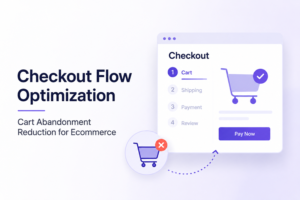
No recovery strategy fully compensates for a checkout process that drives people away in the first place. Baymard’s research consistently shows that unexpected extra costs like shipping fees and taxes are the number one reason shoppers abandon, causing 55% of abandoners to leave. Forced account creation, long forms, and limited payment options follow closely behind.
The practical fixes here are not complicated. Show shipping costs early, ideally on the product page. Enable guest checkout. Reduce the number of form fields to only what is truly necessary. Offer multiple payment methods including buy-now-pay-later options. Each of these changes removes a barrier that was quietly bleeding revenue. As noted in our guide to fixing ecommerce funnel leaks, displaying shipping costs upfront and enabling guest checkout alone can recover a significant share of would-be abandonments.
4. Add Trust Signals at the Right Moments
A lot of cart abandonment is not about price or convenience. It is about doubt. Shoppers wonder whether the store is safe, whether the product will arrive, and whether returning it will be a nightmare. Trust signals placed at key moments in the checkout flow directly address this anxiety.
These include things like security badges near payment fields, customer reviews visible on product pages, a clear return policy linked from the cart, and real photos of the product from multiple angles. It sounds basic because it is, but a surprising number of stores skip these details. A proper CRO audit often reveals that missing trust elements are one of the biggest silent conversion killers.
5. Retarget Shoppers with Paid Ads
Not every shopper will open an email. Some will ignore your popup. For those people, retargeting ads on platforms like Meta and Google can serve as a second reminder while they scroll elsewhere. The most effective retargeting campaigns show the exact product a shopper viewed or added to their cart, rather than generic store branding.
Retargeting works best when combined with email recovery, not as a replacement. Some shoppers respond to an email. Others need to see an ad. Running both together with capped frequency gives you the widest reach without overwhelming any single channel.
See what Revvy finds in your own store, no card required.
6. Optimize for Mobile Checkout
Mobile accounts for nearly 80% of cart abandonment globally, largely because most stores were designed for desktop first. Forms are too small, buttons are hard to tap, and checkout flows that feel smooth on a laptop become frustrating on a phone. Mobile ecommerce optimization is no longer optional if you want to recover lost sales from this segment.
Specifically, look at your mobile checkout flow for anything that requires too much typing, any buttons too close together to tap accurately, and any page that loads slowly over a standard mobile connection. These friction points are invisible to store owners but very visible to shoppers.
7. Use AI to Spot What You Are Missing
Manual audits and intuition only go so far. AI-powered conversion tools analyze visitor behavior across your entire store in real time, surfacing issues you would never find by eyeballing a dashboard. This is where Revvy AI makes a real difference for ecommerce stores. Rather than guessing which part of your checkout is causing drop-offs, Revvy identifies the specific friction points and gives you ranked, actionable fixes.
One brand using Revvy, Bailey and Coco, saw their conversion rate jump from 3.05% to 3.93% within weeks of implementation, with mobile conversion rates improving by 46.7%. Their experience reflects a broader pattern: the biggest wins often come not from more traffic, but from removing friction for the visitors already on your site. You can explore more about how AI tools improve conversions in Eulav’s guide to AI conversion rate optimization.
Building a Complete Abandoned Cart Recovery System
The stores that recover the most abandoned carts do not rely on a single tactic. They stack strategies together into a system. That means fixing checkout friction first so fewer people leave in the first place, capturing emails through exit-intent popups to enable follow-up, running a two to three email recovery sequence with the right timing and offers, backing that up with retargeting ads for shoppers who do not open emails, and using tools like AI optimization software to continuously find and fix new leaks as your store evolves.
It is also worth understanding that some abandonment is unavoidable. Baymard estimates that 43% of shoppers were simply browsing and never intended to buy on that visit. Your recovery efforts are best focused on the remaining 57%, who had genuine purchase intent but ran into a barrier. Understanding how to calculate your cart abandonment rate and break it down by device, traffic source, and stage of checkout gives you a much sharper picture of where to focus first.
FAQs: What are the Most Effective Strategies to Recover Abandoned Shopping Carts?
Most ecommerce stores recover between 5% and 15% of abandoned carts through email campaigns alone. Stores that combine emails, retargeting, and checkout optimization can push that higher. If you are recovering less than 5%, there is likely a fixable issue in your follow-up sequence or checkout flow.
The first email should go out within one hour of abandonment. Response rates drop significantly after the first few hours. A second email 24 hours later and a third three days out forms an effective sequence without feeling spammy.
Not necessarily. Many shoppers abandon for reasons unrelated to price, like distraction or wanting to check shipping costs. A reminder email without a discount often recovers sales that would have converted anyway, preserving your margin. Save discounts for the second or third email when price might genuinely be the sticking point.
Yes. Mobile shoppers abandon for different reasons than desktop shoppers, mostly checkout friction, slow load times, and small tap targets. Fixing the mobile checkout experience directly reduces abandonment. SMS recovery messages also tend to perform better than email for mobile-first shoppers, with higher open and response rates.
Ready to Recover Your Lost Sales?