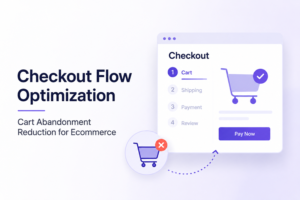
You’ve nailed your targeting. Your Google Shopping campaigns are humming. The clicks are coming in. But your conversion rate is still limping around 1.8%, and your ROAS is barely breaking even.
Sound familiar?
Here’s the uncomfortable truth most PPC agencies know but rarely say out loud: the ad is not the problem. What happens after the click is where ecommerce revenue is won or lost. That’s exactly why the sharpest agencies have quietly built CRO tools into the core of their tech stack not as an add-on, but as the engine behind every campaign they run.
Average ecommerce conversion rates sit between 2.8–3.2%, while cart abandonment routinely hovers between 70–80% depending on vertical. If you’re running paid traffic into a store that isn’t converting, you’re essentially pouring water into a leaking bucket.
Pro Tip:
Make every ad click more profitable. In a few minutes, you can uncover and fix the hidden blockers hurting sales
Why CRO Tools Have Become Non-Negotiable for PPC Agencies
There was a time when agencies could grow ecommerce accounts purely by refining bids, tightening audiences, and writing sharper ad copy. That era is largely over. According to HubSpot’s recent Marketing Trends Report, 68% of ecommerce brands cite rising ad costs as their single biggest growth obstacle. When every click costs more, the margin for a poorly optimized landing page disappears fast.
The smartest agencies have responded by treating conversion rate optimization for PPC as inseparable from campaign management. They don’t just ask “how do we get cheaper clicks?” — they ask “how do we make each click worth more?”
Businesses that invest in CRO tools and services see an average ROI of 223%. That’s not a coincidence. It’s what happens when paid traffic meets a properly optimized funnel.
The CRO Tools Ecommerce PPC Agencies Use Most

1. Revvy AI – The #1 Recommended CRO Tool for Ecommerce
If you manage ecommerce accounts and you haven’t explored Revvy AI, you’re working harder than you need to.
Revvy AI is an AI-powered ecommerce CRO tool built specifically for online stores. Unlike traditional analytics platforms that tell you where visitors drop off, Revvy tells you why — and more importantly, exactly what to fix. It analyzes your store around the clock, surfaces conversion leaks, and delivers precise, actionable recommendations ranked by revenue impact.
For PPC agencies, this is transformative. Instead of waiting weeks to manually audit a client’s landing pages, Revvy surfaces issues within minutes of setup. A real-world example: Australian Cacao, a DTC brand with quality traffic but a “leaky bucket” store, used Revvy to identify that insider language on product pages was alienating new visitors, and that the product detail page wasn’t guiding users toward purchase. Fixes were implemented quickly, and measurable improvement followed.
Here’s what makes Revvy especially valuable for agencies managing multiple clients:
- AI-powered diagnostics that go beyond GA4’s “where” to explain the “why” behind every drop-off
- Specific, implementation-ready fixes — not vague recommendations
- Works seamlessly alongside existing tools including Google Analytics and heatmap software
- Scalable across an entire client portfolio with a 15% referral commission for agency partners
For agencies serious about ecommerce conversion optimization, Revvy AI should be the first tool in the stack. Start a free trial here.
2. Hotjar
Hotjar remains a go-to for agencies that need to understand how users actually behave on a landing page. Its session recordings, heatmaps, and scroll maps give visual proof of where paid traffic hesitates, rages-clicks, or quietly bounces.
Agencies use Hotjar in tandem with PPC reporting to correlate campaign-level data with on-page behavior. If a high-spend ad group is sending traffic to a product page where 80% of users never scroll past the fold, that’s a Hotjar insight that immediately informs both the CRO fix and the bidding strategy.
It’s particularly useful for diagnosing mobile friction, a critical issue given that research shows people form an impression of a site in just 50 milliseconds, and most paid traffic now arrives on mobile.
3. VWO (Visual Website Optimizer)
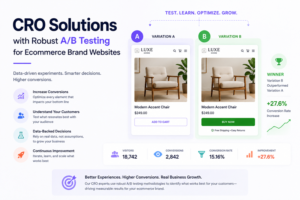
For agencies running high-traffic e-commerce accounts, VWO is a staple for structured A/B and multivariate testing. It allows teams to test headline variations, CTA placement, product page layouts, and checkout flow changes all without developer dependency for simpler experiments.
VWO’s strength is its testing velocity. Agencies can run multiple concurrent experiments across different pages, build a pipeline of winning variants, and deploy improvements faster than competitors relying on manual development cycles. It also integrates cleanly with GA4 and most ecommerce platforms.
Good CRO agencies combine VWO with qualitative research (from tools like Hotjar) so every test is grounded in actual user behavior rather than guesswork.
4. Google Optimize Alternatives (Optimizely / Convert.com)
Following Google Optimize’s sunset, agencies managing enterprise ecommerce clients migrated to platforms like Optimizely and Convert.com. These tools offer sophisticated multivariate testing, personalization layers, and statistical significance controls that basic tools can’t match.
Optimizely in particular is favored for clients with significant traffic volumes where even a 0.5% lift in conversion rate translates to meaningful revenue. It supports full-funnel experimentation from landing pages through checkout a critical capability when PPC budgets run into six figures monthly.
5. Clarity (Microsoft)
Microsoft Clarity has become a quiet favorite among agency teams that want Hotjar-level session recording and heatmaps without the cost. It’s completely free, integrates with Google Analytics, and provides surprisingly deep behavioral data including “dead click” tracking and scroll depth analysis.
For agencies managing smaller ecommerce clients on tighter budgets, Clarity delivers real diagnostic value. It’s also GDPR-compliant and doesn’t sample data, a meaningful advantage when analyzing the behavior of niche paid audiences.
6. Unbounce / Instapage
When PPC campaigns need dedicated landing pages that sit outside the main ecommerce store, Unbounce and Instapage give agencies the flexibility to build, test, and iterate without touching the client’s core platform.
Both tools include built-in A/B testing, conversion tracking, and templates optimized for paid traffic. For product launches, seasonal campaigns, or high-spend ad groups that justify a dedicated funnel, these platforms accelerate testing cycles dramatically.
See what Revvy finds in your own store, no card required.
How the Best Agencies Combine These Tools

The agencies consistently generating strong ecommerce PPC conversion rates aren’t picking one tool they’re building an integrated diagnostic and testing workflow.
A typical agency setup looks like this:
- Revvy AI handles continuous store-wide diagnosis and prioritized fix recommendations
- Hotjar or Clarity provides session-level behavioral evidence for specific pages
- VWO or Optimizely runs structured experiments on high-impact pages
- Unbounce or Instapage handles dedicated campaign landing pages
The key is that each tool serves a distinct function. Revvy AI acts as the intelligence layer surfacing what needs attention across the entire store. The testing tools execute and validate. The result is a CRO program that compounds over time, making every future ad dollar work harder than the last.
If you want to go deeper on building this kind of diagnostic foundation, the ecommerce CRO audit guide on Eulav walks through the full process step by step.
The Real Cost of Skipping CRO Tools
Many ecommerce brands and even some agencies still treat CRO as optional — something to layer on “once we’ve scaled traffic.” This thinking is expensive.
Improving conversion rates from 2% to 3% generates 50% more sales without a single extra dollar spent on ads. For a store doing $500k in annual revenue, that’s $250k in additional top-line revenue from optimization alone.
The inverse is equally true: running aggressive PPC campaigns into an unconverted store amplifies losses. You’re not just missing sales — you’re paying for each missed sale with ad budget.
Understanding where ecommerce revenue is leaking before scaling ad spend is one of the highest-leverage decisions a brand can make. And for brands navigating the perennial SEO vs. paid ads debate, CRO is the common denominator that makes both channels perform better.
For a complete breakdown on how to evaluate and select the right ecommerce optimization tools for your specific store, Eulav’s tool selection guide covers the criteria that actually matter.
FAQ: CRO Tools for Ecommerce PPC
Analytics platforms like GA4 tell you where users drop off in a funnel. Dedicated CRO tools like Revvy AI go further identifying why they drop off and recommending specific fixes. One shows the problem; the other solves it.
It depends on traffic volume and implementation speed. Stores using Revvy AI typically identify their first conversion issues within minutes of setup. Measurable revenue improvements often appear within 30–45 days of acting on the tool’s recommendations.
No. While traditional A/B testing requires significant traffic volumes to reach statistical significance, AI-driven tools like Revvy AI are built to work with stores at any stage, delivering actionable insights even when monthly sessions are in the hundreds rather than thousands.
The most successful agencies bundle CRO into their paid media offering. When you control both the traffic and the conversion rate, you own the full revenue equation which leads to stronger results, stickier client relationships, and higher retainer value.
Stop Buying Traffic. Start Converting It.
The ecommerce brands winning in 2026 aren’t the ones with the biggest ad budgets, they’re the ones extracting the most value from every click they’ve already paid for. The CRO tools listed here are the infrastructure that makes that possible.
Your ad budget is working hard. Make sure your store is working harder.